
Download
MR= (M-M e ) (M 0 -M e ) , ( 1 ) MR= M M 0 . (2) χ 2 = ∑ i-1 N (MR exp -MR pre ) 2 N-z , (3) MBE= 1 N ∑ i-1 N (MR exp -MR pre ) , (4) RMSE= 1 N ∑ i-1 N (MR exp -MR pre ) 2 1/2 , (5) V= 4 3 πR e 3 . (6) MR= 6 π 2 ∑ n − 1 ∞ exp -n 2 π 2 D eff t R e 2 , (7) k= π 2 D eff R e 2 , (8) D eff =D 0 exp E a RT , (9) ln(D eff )=ln(D 0 ) − E a R 1 T . (10)
ORIGINAL ARTICLE
Investigation on thin-layer drying kinetics of sprouted wheat in a tray dryer
M.R. Manikantan1, D. Mridula2, Monika Sharma3, Anita Kochhar4, V. Arun Prasath5, Abhipriya Patra5, R. Pandiselvam1*
1Physiology, Biochemistry and Post-Harvest Technology Division, ICAR-Central Plantation Crops Research Institute (CPCRI), Kasaragod, Kerala, India;
2ICAR-Central Institute of Post-Harvest Engineering and Technology, Ludhiana, Punjab, India;
3ICAR-National Dairy Research Institute, Southern Regional Station, Bangalore, India;
4Punjab Agricultural University, Ludhiana, Punjab, India;
5Department of Food Process Engineering, National Institute of Technology, Rourkela, Odisha, India
Abstract
The thin-layer drying behavior of sprouted wheat (cv. PBW 550) was experimented at different drying periods, such as 24 h, 36 h and 48 h. The samples were dried in a tray dryer at 50–80οC at an interval of 10°C. The moisture ratio was fitted to the six thin-layer drying models, and the performance of the models was assessed by statistical parameters. The Wang and Singh model has accurately predicted the drying behavior of sprouted wheat for all sprouting periods and drying temperatures. In addition, the effective moisture diffusivity of grain sprouts at three drying periods (24 h, 36 h and 48 h) of sprouted wheat was increased from 1.79 × 10⁻⁹ to 2.58 × 10⁻⁹ m2 s-1, 1.921 × 10⁻⁹ to 2.781 × 10⁻⁹ m2 s-1 and 1.858 × 10⁻⁹ to 2.561 × 10⁻⁹ m2 s-1 with increase in drying temperature from 50oC to 80oC. Moreover, at the above-stated drying periods, the activation energy for sprouted wheat was 11.357 kJ mol-1, 11.428 kJ mol-1 and 9.427 kJ mol-1, respectively. Therefore, thin-layer drying of sprouted wheat was successfully simulated between 50°C and 80°C for various drying periods. This study provided imperative information to understand the drying behavior and relationship between various drying parameters of sprouted grains that could produce nutritive functional flour.
Key words: sprouted wheat, mathematical modeling, drying characteristics, effective moisture diffusivity, activation energy
*Corresponding Author: R. Pandiselvam, Physiology, Biochemistry and Post-Harvest Technology Division, ICAR-Central Plantation Crops Research Institute (CPCRI), Kasaragod, Kerala, India. Emails: [email protected] ; [email protected]
Received: 25 April 2022; Accepted: 7 August 2022; Published: 8 October 2022
Doi: http://dx.doi.org/10.15586/qas.v14iSP1.1114
© 2022 Codon Publications
This is an Open Access article distributed under the terms of the Creative Commons Attribution-NonCommercial-ShareAlike 4.0 International (CC BY-NC-SA 4.0). License (http://creativecommons.org/licenses/by-nc-sa/4.0/)
Practical application
Consumers are liable for using health-promoting products obtained from various traditional food products. Wheat is an important food grain, popularly known for its flour being used in several food formulations over the decades. Nevertheless, the wheat flour has margins for shortage of amino acids, protein content, starch and excess of anti-nutritional and flatulence causing units that can be taken care of by one of the simplest methods called ‘sprouting’. Before making flour, drying is a common procedure to preserve sprouted wheat grain for a longer duration without affecting its nutritional and sensory properties. Hence, drying with hot convective air in a controlled cabinet is faster and hygienic for industrial purposes. The present study deals with the thin-layer drying characteristics of sprouted wheat at different periods and air temperatures. Moreover, this study establishes the required level of moisture content of sprouted wheat flour to allow safe storage over a longer period and brings a substantial reduction in weight and volume, thereby minimizing packaging, storage and transportation costs.
Introduction
Wheat is a very popular grain worldwide because of its agronomical adaptability, its flour utilization in different food formulations, and storage simplicity. However, the nutritional quality of wheat becomes inferior because of shortage in certain essential amino acids, gluten intolerance to a certain segment of the population, and lower protein and starch contents. Sprouting of grain enhances its nutritive value (Lemmens et al., 2019; Liu et al., 2022). Various nutritional elements, such as vitamins, minerals and some nutritional trace elements, are increased by sprouting (Akkad et al., 2021; Ertaş, 2015; Marchini et al., 2021). In addition, sprouting effectively reduces phytic acid and flatulence and generates oligosaccharides, such as stachyose and raffinose. Moreover, protein digestibility, as well as sensory properties, is enhanced (Faltermaier et al., 2015; Seguchi et al., 2010). The process of sprouting has been opted for cereal seeds since decades, as it softens the kernel structure and enhances their nutritional values by mitigating anti-nutritional factors. Furthermore, the flour produced from fermented and sprouted cereal seeds is available for in vitro protein and starch digestibility (Baranzelli et al., 2018; Liu et al., 2017). Improvement in nutritional properties is mainly affected by the type and quality of cereal seeds, sprouting, and drying conditions (Lemmens et al., 2019). Hence, it affects quality and commercial application of grain. Sprouted grains can be kept for a few days to over a week under refrigeration. After drying, these can be used in various food products such as breakfast items, soups, pasta, cereal-based beverages and weaning foods. Therefore, information regarding distribution of moisture and temperature in food products should be known for designing of drying process and control of food quality.
The drying of food is one of the complex phenomena that tells its drying behavior. Optimization of drying behavior is a very tedious process and can be done by mathematical models (Delfiya et al., 2022; Jeevarathinam et al., 2021; Pravitha et al., 2022). Among those models, the thin-layer drying empirical models are mainly considered based on the product characteristics. There are some relevant studies on the thin-layer drying of various foods, such as slices of red beetroot (Dasore et al., 2020), lemon verbena leaves (Ghasemi et al., 2021), red amaranth leaves (Sultana and Ghosh, 2021), taro roots (Nipa and Mondal, 2021), cassava starch (Aviara and Igbeka, 2016), and finger millet. Even though extensive studies have investigated the drying of wheat (Hosain et al., 2016; Mykhailyk et al., 2016), a very few works of literature have studied drying characteristics of sprouted grains (Dziki et al., 2015; Shingare and Thorat, 2013). Since drying is crucial for producing weaning and other value-added products from sprouted wheat, the current study was conducted on the thin-layer drying characteristics of sprouted wheat. Hence, the present work was intended to: (a) investigate the thin-layer drying kinetics of sprouted wheat using a mechanical tray dryer, (b) establishing an appropriate mathematical drying model, and (c) evaluating effective moisture diffusivity and its respective activation energy of sprouted wheat at different drying periods and temperatures.
Materials and Methods
Preparation of sample
The study was conducted in the Food Grains and Oilseeds Processing Division of the Central Institute of Post-Harvest Engineering and Technology, Ludhiana, Punjab, India. The wheat samples (cv. PBW 550) were taken from the Punjab Agricultural University, Ludhiana, Punjab, India. Once the cleaning was completed, the samples were soaked in distilled water at a ratio of 1:2 in a glass container for recommended least time of soaking, that is, 8 h at room temperature. Then, the seeds were taken out from the container and gently rolled over a thick absorbent cloth to remove adherent moisture. Finally, in order to sprout, the grains were preserved in a humidity- and temperature-controlled cabinet having a constant relative humidity (RH) of 95% and temperature of 35°C in darkness. The time for sprouting was taken as 0 (s) while the soaked sample was kept in a germination chamber.
Experimental set-up
The experiment was performed in triplicate for each drying period of 24 h, 36 h and 48 h in the laboratory of Food Grains and Oilseeds Processing Division. Only distilled water was sprinkled on the grains during sprouting period at an interval of 8 h for washing the sample to avoid mould and fungus infection. The sample was kept for 3 days till the sprouts were observed. After sprouting, the sprouted wheat samples with initial moisture content (M; % wet basis [wb]) of 32–35% were subjected to drying at 50οC, 60οC, 70οC and 80οC at different time intervals. The drying was exercised in a mechanical convective tray dryer (Model-MSW 216; Macro Scientific Works, Delhi, India) till the moisture content (% wb) ranged between 7% and 10%. The moisture content of the wheat grain sample was determined by drying in a hot air oven at 105°C till it achieved a constant weight (Horwitz, 2010).
The following equation represented the moisture ratio (MR) of the grain sample while drying:
where MR is the moisture ratio (dimensionless), and M, Mo and Me are the instantaneous (at time t [s]), initial and equilibrium moisture contents, respectively.
The value of Me was comparatively lower than that of M or Mo. Hence, MR was simplified as follows (Kertész et al., 2015; Motevali et al., 2013):
The relationship between MR and drying periods was represented by drying curves/models fitted in six different thin-layer drying mathematical equations. The drying curves/models are described in Table 2, from which the best fit model was evaluated to define the drying process of sprouted sample.
Drying
Sprouted wheat was dried in a tray dryer at an air temperature of 50, 60, 70 and 80 ± 1οC for different drying periods of 24 h, 36 h and 48 h. In order to have uniform drying, 500-g of sprouted wheat was homogeneously spread as a layer on a perforated stainless steel tray. A constant temperature was maintained during drying by turning off heaters and blowers. In every run, the air was blown at a constant velocity of 3.7 m/min, suitable for drying as suggested by Soydan and Doymaz (2021). The constant velocity was maintained to achieve uniform drying of the sample. The moisture loss was noted using a digital balance with a least count of 0.01 mg at an interval of 1 h. Then, the drying was continued up to a steady magnitude of moisture loss. The drying air was not regulated by its relative humidity, which varied from 18% to 45%. Each experiment was conducted in triplicate.
Statistical analysis
The nonlinear regression equations were analyzed by the MATLAB (version 6.5) software. The model was chosen as the best fitting model according to its coefficient of determination (R2) and coefficient of correlation (r) . In addition, the selection criteria of the models were evaluated using different statistical parameters, such as standard error (SE), root mean square error (RMSE), reduced Chi-square (χ2), and mean bias error (MBE). According to Pandiselvam et al. (2017), the value of R2 must be more significant, and the values of rest of ancillary parameters must be lower for the best fit model. Equations (3)–(5) represent ancillary parameters:
and
where MRexp and MRpre are observed and predicted moisture ratios; z and N are drying constant and experiment numbers, respectively.
Calculation of effective moisture diffusivity (Deff)
Fick’s diffusion law was applied to define drying, with diffusivity assumed to be constant (Suna and Özkan-Karabacak, 2019). The mean volume (V, in m3) of sprouted wheat, calculated as 0.06 cm3, was obtained by the toluene displacement procedure. Here, the mean equivalent radius (Re) of sprouted grain sample was 2.43 × 10⁻³ m, which was calculated by using Equation (6):
The universal series of Fick’s equation representing MR with spherical coordinates is given by
where MR is the moisture ratio, Re is the equivalent radius (m), Deff is the effective diffusivity (m2 s-1), and t is the drying time (s). In Fick’s equation, the first term is identified as Henderson and Pabis model. The moisture diffusivity relates to the slope and coefficient k, which is given by
Determination of activation energy
According to Bozkir (2020), the following relationship, known as the Arrhenius equation, represents the activation energy required for drying:
where Deff, is the effective moisture diffusivity (m2/s), Ea is the activation energy (kJ/mol), R is the universal gas constant (8.314 kJ/mol), and T is the absolute air temperature (K [Kelvin]). The intercept of y-axis represents the constant Do derived from the graph.
Equation (9) can be written in a linear form by considering natural logarithm on two sides and is given by
The value of Ea was evaluated from the slope of graph between logarithmic (ln) (Deff) and 1/T from Equation (10).
Results and Discussion
Drying kinetics data are important to find out optimum drying conditions for a specific product and also for designing a suitable dryer. Besides, several research articles have studied the physical, chemical, nutritional, cooking and sensory qualities of sprouted wheat at different time periods (Mridula et al., 2015, 2013). The stated properties significantly improved in sprouted wheat as compared to control unsprouted wheat. Considering the physical properties, the bulk density was lowered and the true density was ameliorated due to sprouting. Besides, yellow and red colors of sprouted wheat were lowered. Moreover, the cooking time was reduced in case of sprouted wheat, and solid loss was increased by the sprouting process. However, the sprouting process lowered the moisture content of wheat grains whereas other nutritional qualities were improved significantly. The sensory qualities of sprouted wheat, for instance appearance, texture, flavor and overall acceptability, were increased significantly in sprouted grains compared to control wheat grains. In most of the studies, the wheat grains are kept for 2–3 days for having improved qualities. All the properties of both sprouted wheat grains kept for 36 h and control unsprouted wheat grains are given in Table 1.
Table 1. List of physiochemical, cooking, nutritional and sensory properties of unsprouted and sprouted wheat grains (Mridula et al., 2015, 2013).
| S. No. | Properties | Name of the properties | Units | Unsprouted wheat | Sprouted wheat | |
|---|---|---|---|---|---|---|
| 1. | Physical properties | Bulk density | g/mm3 | 0.690 | 0.53 | |
| True density | g/mm3 | 1.33 | ||||
| Porosity | % | 48.07 | ||||
| Peak viscosity | cP | 83.67 | ||||
| Color | L | - | 70.03 | 75.85 | ||
| a | - | 6.94 | 4.55 | |||
| b | - | 20.70 | 16.41 | |||
| Hue angle | - | 71.47 | 74.53 | |||
| Chroma | - | 21.83 | 17.03 | |||
| 2. | Cooking qualities | Cooking time | Min. | 4.41 | 3.91 | |
| Hydration ratio | - | 3.20 | 3.450 | |||
| Solid loss in cooking water | % | 12.66 | 14.29 | |||
| 3. | Nutritional qualities | Moisture | Wet basis (%) | 7.31 | 6.28 | |
| Protein | % | 10.23 | 10.26 | |||
| Fat | % | 1.31 | 1.32 | |||
| Crude fiber | % | 3.19 | 3.23 | |||
| Minerals | % | 1.47 | 1.29 | |||
| Carbohydrates | % | 74.41 | 77.24 | |||
| Calories | kCal/100 g | 350 | 359.31 | |||
| In vitro digestibility | % | 47.46 | 62.75 | |||
| Iron | mg/100 g | 1.11 | 1.18 | |||
| Calcium | mg/100 g | 42.67 | 44.67 | |||
| 4. | Sensory qualities | Appearance and color | Hedonic scale | 7.75 | 8.08 | |
| Texture | Hedonic scale | 7.71 | 7.71 | |||
| Flavor and taste | Hedonic scale | 7.96 | 8.25 | |||
| Mouth feel | Hedonic scale | 7.67 | 7.67 | |||
| Overall acceptability | Hedonic scale | 7.69 | 7.98 | |||
Table 2. Thin-layer drying models given by various authors.
| Model Names | Equations | References |
|---|---|---|
| Newton | MR = e–kt | Motevali et al., 2013 |
| Wang and Singh | MR = 1 + at + bt2 | Manikantan et al., 2014) |
| Henderson and Pabis | MR = ae–kt | Abbaspour-Gilandeh et al., 2020 |
| Two-term | MR = ae–k0t + be–k1t | Onwude et al., 2016 |
| Logarithmic | MR = ae–kt + c | Darvishi et al., 2014 |
| Page | MR = e–ktn | Doymaz and Smail, 2011 |
Apart from sprouting of wheat grains, studies have been conducted on sprouting of other grains to analyze physiochemical, nutritional, functional and microstructural properties. In a study of wheat noodles, Zhang et al. (2022) investigated the quality of noodles after adding sprouted quinoa flour into wheat flour. By addition of quinoa flour, the cooking and water absorption rate were significantly reduced without changing the texture of noodles. On the other hand, the sprouted Nitta bean flour had higher phenolic content and antioxidant activity along with more physiochemical properties compared to hydrothermal treatments. Moreover, germination caused structural and morphological changes in beans so that gel formation capacity and emulsion capacity were lowered compared to control samples (Medhe et al., 2022).
Rani et al. (2022) investigated physiochemical and anti-nutritional properties of oat flour following the sprouting process. The protein and fiber contents in oat flour were significantly increased after sprouting whereas the color values, such as a* and b*, were reduced significantly. Moreover, the anti-nutritional properties, such as phytic acid and tannin contents, were reduced to a higher amount by the sprouting process. Also, in a study conducted on pigeon pea, sprouting enhanced the protein and fiber contents along with minerals, vitamins, phenolic compounds, resistant starch, protein digestibility, and antioxidant properties. However, sprouting of pea reduced some amino acids, phytic acid and trypsin inhibitor activity (Chinma et al., 2022). It is clear from the above studies that sprouting of grains or pulses for certain period induces their qualities.
In case of winter jujube slices, nutritional factors, such as vitamins, total acidity and reducing sugar content, were reduced significantly with increase of drying time, air velocity and temperature (Niu et al., 2021). Also, Doymaz and Karasu (2018) investigated the drying of sage leaves under low temperature (45°C), with restrained phenolic content and antioxidant activity. The drying kinetics revealed direct dependency between drying temperature and drying period. Changes in drying period were determined by MR. Therefore, application of thin-layer drying kinetics model could predict relation of moisture evaporation with drying time and temperature; the nutritional and physiochemical properties could be preserved for a longer period by drying for certain period and temperature.
Effect on moisture ratio
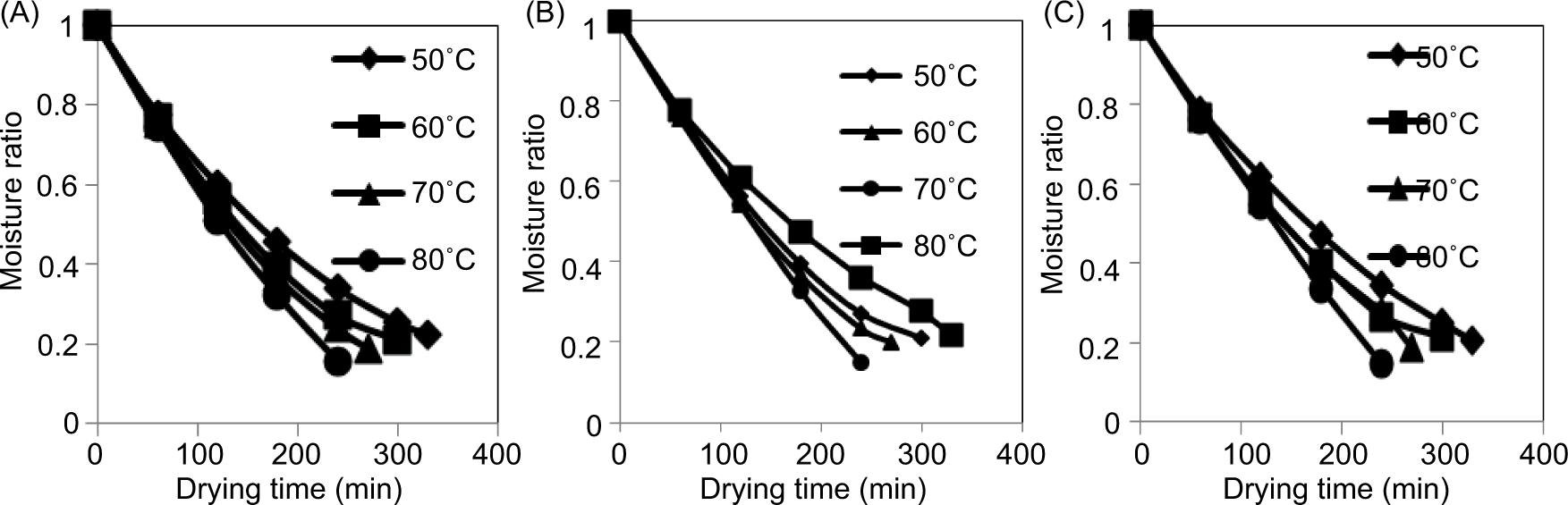
The impact of drying periods and air temperatures on the MR of sprouted wheat is presented in Figure 1. The figure shows the continuous reduction of MR pertaining to rise in drying period; this indicated that drying occurred with a decrease in rate period and an increase in drying time. This consideration indicated that moisture movement in the sample followed the liquid and vapor diffusion mechanism as described by Behera et al. (2021). As expected, rise in drying air temperature lessened the relative humidity, thus raising the moisture difference between surrounding air and grains. Heat transfer between the product to be dried and the drying air was gradually increased so that moisture migrated rapidly (Nag and Dash, 2016; Sayyad et al., 2021). In the primary phase, drying started rapidly because of the presence of free moisture. Then, the drying rate decreased gradually at the final stage by lowering the movement of moisture from inward to outward surface (Taheri-Garavand et al., 2011). In addition, with rise in air temperature, the drying period was reduced. This demonstrated that a certain level of moisture ratio was reached first at a higher temperature. The present study revealed that drying air temperature was vital for deviations in drying time. Some identical results were observed by the following researchers: Aviara and Igbeka (2016) for cassava starch, Ee et al. (2021) for kedondong fruit, Gazor and Mohsenimanesh (2010) for canola, Ingle et al. (2019) for bottle gourd, Kertész et al. (2015) for carrot slices, Markowski et al. (2010) for barley, Moezzi et al. (2021) for grapefruit, Nipa and Mondal (2021) for taro roots, Rayaguru and Routray (2012) for apple slices, Shen et al. (2011) for sweet sorghum stalk, and Taheri-Garavand et al. (2011) for bell pepper.
Figure 1. Thin-layer drying curves of different period sprouted wheat at four different air temperatures. (A) 24 hours; (B) 36 hours; (C) 48 hours.
Comparison between models
The drying procedure was examined with six different drying models for its fitness by determining the moisture ratio of sprouted wheat at three drying air temperatures and drying periods. Table 3 presents the detailed statistical results of analyses, such as r2, SE, χ2, MBE and RMSE. These results were attained from nonlinear regression analysis by using MATLAB for six drying models. According to the higher value of r2 and the lower values of SE, χ2, MBE and RMSE, the best fit model was designated to define the drying characteristics of sprouted wheat (Demiray et al., 2017; Mbegbu et al., 2021; Onwude et al., 2016). It was observed that all models were good fit for drying processes having r2 > 0.99. As shown in Table 3, Wang and Singh’s empirical equation perfectly illustrated the drying characteristics of sprouted wheat with greater importance to the correlation coefficient of all drying temperatures and sprouting periods. In addition, this model was suitable for fit drying kinetics, as observed by Akpinar (2010) for mint leaves, Farhang et al. (2010) for alfalfa, Ghasemi et al. (2021) for lemon verbena leaves, Kumar et al. (2013) for bamboo shoots slices, and Manikantan et al. (2014) for paddy. Moreover, numerous studies (Agarry, 2016; Demiray and Tulek, 2012; Nag and Dash, 2016; Torres-Ossandón et al., 2018) have demonstrated that the drying models give useful information to evaluate optimal drying conditions, such as temperature and time to attain an ultimate moisture value for sprouted wheat for further processing. Hence, information on drying kinetics and its modeling is necessary for designing, simulation and optimization of drying processes.
Table 3. Drying constants and statistical parameters attained from the six certain drying models for sprouted wheat at different drying timings and air temperatures.
| Sample condition (sprouting period, drying temperature) | Model Names | Constants | R2 | SE | MBE | χ2 | RMSE |
|---|---|---|---|---|---|---|---|
| 24 h, 50oC | Newton | k = 0.004390755 | 0.999136 | 0.008419 | 0.00052 | 8.01494E-05 | 0.008288513 |
| Wang and Singh | a = –0.0038704294 b = 4.6717404e-006 |
0.999878 | 0.003466 | 0.000146 | 1.0915E-05 | 0.002675691 | |
| Henderson and Pabis | a = 1.0080396 k = 0.0044346021 |
0.999318 | 0.008192 | 0.001962 | 7.70394E-05 | 0.007418097 | |
| Two-term | a = 0.49487101 k0 = 0.0044291665 b = 0.51316614 k1 = 0.0044396937 |
0.999318 | 0.010576 | 0.001965 | 0.000128433 | 0.007419089 | |
| Logarithmic | a = 1.0643075 k = 0.0039725023 c = -0.062088415 |
0.999766 | 0.005367 | 0.0014 | 2.06668E-05 | 0.003436509 | |
| Page | k = 0.0033309755 n = 1.051801 |
0.999874 | 0.003517 | 0.001412 | 1.12448E-05 | 0.002834076 | |
| 36 h, 50oC | Newton | k = 0.0042724165 | 0.998345 | 0.011516 | 0.000277 | 0.000162335 | 0.011795944 |
| Wang and Singh | a = -0.0037136246 b = 4.2266864e-006 |
0.999323 | 0.007405 | 0.000203 | 0.000166973 | 0.00620926 | |
| Henderson and Pabis | a = 1.0069057 k = 0.0043096496 |
0.998484 | 0.012074 | 0.000981 | 0.000183816 | 0.011458488 | |
| Two-term | a = 0.49845292 k0 = 0.004323715 b = 0.50845279 k1 = 0.0042958557 |
0.998484 | 0.015588 | 0.000982 | 0.000306379 | 0.01145886 | |
| Logarithmic | a = 1.1022023 k = 0.0036146467 c = -0.10411231 |
0.999175 | 0.007943 | 0.000209 | 7.97741E-05 | 0.00675168 | |
| Page | k = 0.0032099774 n = 1.0534994 |
0.999133 | 0.009129 | 0.000732 | 0.000118046 | 0.009182496 | |
| 48 h, 50oC | Newton | k = 0.0043789399 | 0.993968 | 0.02286 | 0.000524 | 0.000418533 | 0.01894049 |
| Wang and Singh | a = -0.0035891286 b = 3.5830869e-006 |
0.999974 | 0.002187 | 0.001038 | 3.55291E-05 | 0.00303765 | |
| Henderson and Pabis | a = 1.0190995 k = 0.004481155 |
0.994951 | 0.02291 | 0.002993 | 0.000425471 | 0.017432947 | |
| Two-term | a = 0.50454831 k0 = 0.0044753589 b = 0.51454857 k1 = 0.0044867184 |
0.994951 | 0.029577 | 0.002995 | 0.000709133 | 0.017433135 | |
| Logarithmic | a = 1.2836798 k = 0.0029396301 c = -0.28430143 |
0.999951 | 0.002536 | 0.00104 | 1.93595E-05 | 0.003326048 | |
| Page | k = 0.0020269304 n = 1.1442255 |
0.999055 | 0.00991 | 0.002051 | 9.07097E-05 | 0.008049389 | |
| 24 h, 60oC | Newton | k = 0.0050773771 | 0.996138 | 0.018926 | 0.002066 | 0.000358205 | 0.01727727 |
| Wang and Singh | a = -0.0043799635 b = 5.7764784e-006 |
0.999512 | 0.007523 | 0.001059 | 5.65998E-05 | 0.006142733 | |
| Henderson and Pabis | a = 1.0162183 k = 0.0051788475 |
0.996874 | 0.019036 | 0.001159 | 0.00036237 | 0.01554285 | |
| Two-term | a = 0.527777224 k0 = 0.0052368523 b = 0.4884494 k1 = 0.0051167846 |
0.996872 | 0.026931 | 0.001165 | 0.000725262 | 0.015548444 | |
| Logarithmic | a = 1.1152749 k = 0.0043163657 c = -0.10774605 |
0.998243 | 0.016479 | 2.54E-07 | 0.000271573 | 0.011652738 | |
| Page | k = 0.0028122979 n = 1.1140214 |
0.999281 | 0.00913 | 0.000529 | 8.33597E-05 | 0.007454741 | |
| 36 h, 60oC | Newton | k = 0.0050741664 | 0.995393 | 0.020749 | 0.002258 | 0.000430504 | 0.018940791 |
| Wang and Singh | a = -0.0043498021 b = 5.644663e-006 |
0.999353 | 0.008691 | 0.001247 | 7.55292E-05 | 0.007095971 | |
| Henderson and Pabis | a = 1.0179824 k = 0.0051863915 |
0.996292 | 0.020811 | 0.001328 | 0.000433078 | 0.016991719 | |
| Two-term | a = 0.48932767 k0 = 0.0051466276 b = 0.52865132 k1 = 0.0052232648 |
0.996291 | 0.029435 | 0.001332 | 0.000866396 | 0.016994079 | |
| Logarithmic | a = 1.1338387 k = 0.0042072924 c = -0.12573514 |
0.998065 | 0.017358 | 7.03E-06 | 0.000301296 | 0.012273881 | |
| Page | k = 0.0026167743 n = 1.1278032 |
0.999284 | 0.009148 | 0.000555 | 8.36946E-05 | 0.007469701 | |
| 48 h, 60oC | Newton | k = 0.0050840176 | 0.995628 | 0.020158 | 0.004021 | 0.000734008 | 0.024732036 |
| Wang and Singh | a = -0.0043747135 b = 5.7421359e-006 |
0.999216 | 0.009542 | 0.004567 | 0.000127441 | 0.002313718 | |
| Henderson and Pabis | a = 1.0160328 k = 0.0051843162 |
0.996346 | 0.020603 | 0.001236 | 0.000424466 | 0.016821937 | |
| Two-term | a = 0.49820017 k0 = 0.0051404027 b = 0.51782961 k1 = 0.005226709 |
0.996345 | 0.029141 | 0.001239 | 0.000849217 | 0.016824749 | |
| Logarithmic | a = 1.1226114 k = 0.0042674922 c = -0.1158139 |
0.997896 | 0.018055 | 2.31E-06 | 0.000325983 | 0.012766806 | |
| Page | k = 0.0027822823 n = 1.1163467 |
0.998878 | 0.011418 | 0.000383 | 0.000130373 | 0.009322848 | |
| 24 h, 70oC | Newton | k = 0.005573578 | 0.992092 | 0.028055 | 0.001977 | 0.000787065 | 0.025610297 |
| Wang and Singh | a = -0.004490333 b = 5.5003264e-006 |
0.999904 | 0.003465 | 0.00045 | 1.2004E-05 | 0.002828899 | |
| Henderson and Pabis | a = 1.0230558 k = 0.0057210484 |
0.993451 | 0.028543 | 0.002576 | 0.000814708 | 0.02330533 | |
| Two-term | a = 0.54094272 k0 = 0.0057406455 b = 0.48211976 k1 = 0.0056992913 |
0.993451 | 0.040367 | 0.002576 | 0.001629516 | 0.023306052 | |
| Logarithmic | a = 1.3073288 k = 0.0036498026 c = -0.30338258 |
0.999602 | 0.008128 | 3.01E-08 | 6.6062E-05 | 0.005747261 | |
| Page | k = 0.0020764868 n = 1.1918991 |
0.999858 | 0.004198 | 0.000396 | 1.76238E-05 | 0.00342771 | |
| 36 h, 70oC | Newton | k = 0.0055352988 | 0.992489 | 0.02721 | 0.002126 | 0.000740381 | 0.024839162 |
| Wang and Singh | a = -0.0045109033 b = 5.6562327e-006 |
0.999621 | 0.004838 | 0.00076 | 2.67564E-05 | 0.00358308 | |
| Henderson and Pabis | a = 1.0226635 k = 0.0056800696 |
0.993816 | 0.027603 | 0.002353 | 0.000761938 | 0.022537934 | |
| Two-term | a = 0.54026756 k0 = 0.0056581782 b = 0.48238859 k1 = 0.0057043448 |
0.993816 | 0.039038 | 0.002357 | 0.001523995 | 0.022538816 | |
| Logarithmic | a = 1.2764755 k = 0.0037706389 c = -0.27137054 |
0.999086 | 0.012256 | 6.89E-08 | 0.000150212 | 0.008666381 | |
| Page | k = 0.0021366934 n = 1.1849638 |
0.999775 | 0.005262 | 0.000159 | 2.76878E-05 | 0.004296337 | |
| 48 h, 70oC | Newton | k = 0.0052190283 | 0.987246 | 0.034969 | 0.00825 | 0.000656482 | 0.023389501 |
| Wang and Singh | a = -0.0040456527 b = 3.9933337e-006 |
0.999146 | 0.010996 | 0.008532 | 0.000136412 | 0.008258699 | |
| Henderson and Pabis | a = 1.0255301 k = 0.0053776643 |
0.989009 | 0.036295 | 0.002849 | 0.001317295 | 0.029634379 | |
| Two-term | a = 0.53250586 k0 = 0.0053645893 b = 0.49302156 k1 = 0.0053916959 |
0.989008 | 0.051329 | 0.00285 | 0.002634644 | 0.029634687 | |
| Logarithmic | a = 1.5542401 k = 0.0026925102 c = -0.55399498 |
0.998991 | 0.01168 | 2.36E-07 | 0.000503706 | 0.018324962 | |
| Page | k = 0.0016353612 n = 1.2243713 |
0.997651 | 0.016777 | 0.134394 | 0.035727671 | 0.154332263 | |
| 24 h, 80oC | Newton | k = 0.0061808162 | 0.979192 | 0.048352 | 0.002379 | 0.002337947 | 0.043247633 |
| Wang and Singh | a = -0.0045632708 b = 4.3613613e-006 |
0.999957 | 0.002525 | 0.000174 | 6.37693E-06 | 0.001956057 | |
| Henderson and Pabis | a = 1.0296019 k = 0.006394302 |
0.981571 | 0.052545 | 0.004562 | 0.002760974 | 0.040701162 | |
| Two-term | a = 0.495468 k0 = 0.0063947152 b = 0.53414989 k1 = 0.0063948243 |
0.981571 | 0.091011 | 0.004551 | 0.008282921 | 0.040701158 | |
| Logarithmic | a = 1.8806759 k = 0.0024920358 c = -0.87915999 |
0.999926 | 0.004073 | 5.51E-07 | 1.65896E-05 | 0.00257601 | |
| Page | k = 0.0012014776 n = 1.3273881 |
0.997792 | 0.018186 | 0.001768 | 0.000330714 | 0.014086453 | |
| 36 h, 80oC | Newton | k = 0.0059814928 | 0.9676 | 0.06079 | 0.003253 | 0.003695408 | 0.05437211 |
| Wang and Singh | a = -0.0041448575 b = 2.4726901e-006 |
0.999853 | 0.004721 | 0.000225 | 2.22912E-05 | 0.003657144 | |
| Henderson and Pabis | a = 1.036442 k = 0.0062384386 |
0.971185 | 0.066197 | 0.005472 | 0.004381996 | 0.051275703 | |
| Two-term | a = 0.4983129 k0 = 0.0062373337 b = 0.53811781 k1 = 0.0062391482 |
0.971185 | 0.114656 | 0.005472 | 0.013145989 | 0.051275704 | |
| Logarithmic | a = 2.9372788 k = 0.0014281681 c = -1.9358758 |
0.999822 | 0.00638 | 0.000741 | 4.07078E-05 | 0.004035237 | |
| Page | k = 0.00072031607 n = 1.4216865 |
0.996123 | 0.02428 | 0.002718 | 0.00058953 | 0.018807397 | |
| 48 h, 80oC | Newton | k = 0.0059142997 | 0.964116 | 0.063967 | 0.003415 | 0.004091825 | 0.057214157 |
| Wang and Singh | a = -0.0040104366 b = 1.884286e-006 |
0.999966 | 0.002284 | 7.64E-05 | 5.21651E-06 | 0.001769154 | |
| Henderson and Pabis | a = 1.037557 k = 0.0061769228 |
||||||
| Two-term | a = 0.49998882 k0 = 0.0061783583 b = 0.53756115 k1 = 0.006175343 |
0.967938 | 0.12093 | 0.005656 | 0.014624105 | 0.054081614 | |
| Logarithmic | a = 3.650306 k = 0.0011079726 c = -2.649812 |
0.999949 | 0.003398 | 0.000811 | 1.15457E-05 | 0.002149018 | |
| Page | k = 0.0006516673 n = 1.4388616 |
0.994814 | 0.028081 | 0.003104 | 0.000788529 | 0.021751261 |
a, b, c and n: drying model constants; k: drying rate constant (h-1).
Effect on effective moisture diffusivity
The slope of equation established between ln (MR) and drying period for sprouted wheat dried at different air temperatures showed moisture diffusivity (Felizardo et al., 2021; Taheri-Garavand et al., 2011). Table 4 presents moisture diffusivity at different air temperatures and sprouting periods. Rise in drying air temperature amplified the moisture diffusivity of sprouted wheat. As a result, increase in the vapor pressure of sprouted wheat samples was caused by rapid heating by intense thermal energy as studied by Kadam et al. (2011) in basil leaves and Nipa and Mondal (2021) in taro roots. Moisture diffusivity for the drying period of 24-, 36- and 48-h sprouted wheat was found to increase from 1.790 × 10⁻⁹ to 2.580 × 10⁻⁹ m2 s-1, 1.921 × 10⁻⁹ to 2.781 × 10⁻⁹ m2 s-1 and 1.858 × 10⁻⁹ to 2.561 × 10⁻⁹ m2 s-1, respectively, for the drying air temperatures of 50–80oC. In general, each food material has moisture diffusivity ranging from 10-9 m2 s-1 to 10-11 m2 s-1 with falling time periods, where drying occurs by internal moisture diffusion (Darvishi et al., 2014; Khawas et al., 2014). During the first 36 h of sprouting, the texture was continuously soft compared to the soaked seeds; however, the softness of sprouted seeds decreased thereafter. The effective moisture diffusivity also increased with sprouting period of up to 36 h, but decreased gradually thereafter. According to Joshi et al. (2011), structural components, such as cell walls, proteins and carbohydrates of the cotyledon are broken due to enzymatic action. Some examples of food materials where drying time influences mass transfer are Bambara beans (Awotona et al., 2021), elephant apple (Nag and Dash, 2016) and red amaranths leaves (Sultana and Ghosh, 2021).
Table 4. Effective moisture diffusivity (Deff) at various timings and air temperature for drying of sprouted wheat.
| Drying temperature (°C) | Sprouting period (h) | Deff (×10-9 m2/s) |
|---|---|---|
| 50 | 24 | 1.790 |
| 36 | 1.921 | |
| 48 | 1.858 | |
| 60 | 24 | 2.092 |
| 36 | 2.310 | |
| 48 | 2.149 | |
| 70 | 24 | 2.310 |
| 36 | 2.530 | |
| 48 | 2.229 | |
| 80 | 24 | 2.580 |
| 36 | 2.781 | |
| 48 | 2.561 |
Effect on activation energy
It is observed that the lowest energy allows the movement of water particles inside the solid by breaking water–water and/or water–solid interactions. The lesser activation energy of the grain shows that water molecules can transfer rapidly. It relates to the lowest quantity of energy required for transmission of moisture inside sprouted wheat throughout the drying process. It was calculated from the slope of straight line between logarithmic moisture diffusivity (ln Deff) and absolute temperature (1/T) of Arrhenius expression shown in Equation (10). The activation energy for 24-, 36- and 48-h wheat samples was 11.357 kJ mol-1, 11.428 kJ mol-1 and 9.427 kJ mol-1, respectively. It was observed that 36-h sprouted wheat sample required maximum activation energy to remove sample water. The moisture was firmly bounded to the material structure and its removal required more activation energy (Ea) (Perea-Flores et al., 2012). An inversely proportional relationship was observed between activation energy and temperature, hence Ea decreased with increase in temperature. Apart from this, more activation energy was required with increasing drying period; less Ea was required at a significantly shorter period (<36 h), but more Ea was involved for longer period (>36 h) because of decrease in moisture diffusivity. Some examples of food products which required higher activation energy than observed in the present study are cassava starch (Aviara and Igbeka, 2016), cardamom (Dash et al., 2021), taro roots (Nipa and Mondal, 2021) and amaranth leaves (Sultana and Ghosh, 2021). Likewise, examples of food products requiring lower activation energy than sprouted wheat are chickpeas (Cavalcanti-Mata et al., 2020) and canola (Gazor and Mohsenimanesh, 2010).
Conclusions
The impact of drying air temperature on sprouted wheat at different drying periods in a tray dryer was investigated. It was demonstrated that drying occurred with falling rate period, where the moisture was removed due to diffusion phenomenon. Hence, using the Fick’s equation, it was possible to characterize the drying of sprouted wheat. According to statistical analysis, the Wang and Singh model was described as the most acceptable representation of drying characteristics of sprouted wheat with higher correlation coefficient values and lower ancillary parameters for each drying temperature. Hence, this could be a valuable tool for simulating the drying operations and development of dryers at industrial scale. Moreover, the diffusivity was increased from 1.790 × 10⁻⁹ m2/s to 2.781 × 10⁻⁹ m2/s when both drying air temperature and time were raised. Diffusivity was highest at an air temperature of 80°C used for drying wheat grains for 36 h. Sprouted wheat at a drying period of 36 h required more activation energy to remove its moisture. Based on the Arrhenius equation, activation energy was determined as 11.428 kJ/mol-1 at an air temperature of 80°C. Hence, the drying parameters of sprouted wheat were considerably affected by different drying temperatures and periods using a tray dryer.
Nomenclature
MMoisture content (DB)
NExperiment numbers
zDrying constant numbers
VMean volume (m3)
ReEquivalent radius (m)
TAbsolute air temperature (K)
EaActivation energy (kJ/mol)
tDrying period (h)
DMoisture diffusivity (m2/s)
r2Coefficient of determination
a b, c, nDrying model constants
kDrying rate constant (h-1)
Funding
This research did not receive any specific grant from funding agencies in the public, commercial, or not-for-profit sectors.
Data availability Statement
The data that supported the findings of this study are available from the corresponding author upon reasonable request.
REFERENCES
Abbaspour-Gilandeh, Y., Jahanbakhshi, A. and Kaveh, M., 2020. Prediction kinetic, energy and exergy of quince under hot air dryer using ANNs and ANFIS. Food Science and Nutrition 8(1): 594–611. 10.1002/fsn3.1347
Agarry, S.E., 2016. Modelling the thin-layer drying kinetics of untreated and blanch-osmotic pre-treated tomato slices. Turkish Journal of Agriculture–Food Science and Technology 4(10): 850. 10.24925/turjaf.v4i10.850-858.774
Akkad, R., Buchko, A., Johnston, S.P., Han, J., House, J.D. and Curtis, J.M., 2021. Sprouting improves the flavour quality of faba bean flours. Food Chemistry 364: 130355. 10.1016/j.foodchem.2021.130355
Akpinar, E.K., 2010. Drying of mint leaves in a solar dryer and under open sun: modelling, performance analyses. Energy Conversion and Management 51(12): 2407–2418. 10.1016/j.enconman.2010.05.005
Aviara, N.A. and Igbeka, J.C., 2016. Modeling for drying of thin layer of native cassava starch in tray dryer. Journal of Biosystems Engineering 41(4): 342–356. 10.5307/jbe.2016.41.4.342
Awotona, E.O., Alade, A.O., Adebanjo, S.A., Duduyemi, O. and Afolabi, T.J., 2021. Drying kinetics and moisture diffusivity of four varieties of bambara beans. Engineering and Technology Research Journal 6(1): 30–33. 10.47545/etrj.2021.6.1.074
Baranzelli, J., Kringel, D.H., Colussi, R., Paiva, F.F., Aranha, B.C., Miranda, M.Z. de, et al. 2018. Changes in enzymatic activity, technological quality and gamma-aminobutyric acid, GABA) content of wheat flour as affected by germination. LWT–Food Science and Technology 90: 483–490. 10.1016/j.lwt.2017.12.070
Behera, G., Madhumita, M., Aishwarya, J. and Gayathri, V., 2021. Comparative evaluation of drying kinetics of carrot slices in hot air and microwave drying. Journal of Phytopharmacology 10(4): 242–248. 10.31254/phyto.2021.10405
Bozkir, H., 2020. Effects of hot air, vacuum infrared, and vacuum microwave dryers on the drying kinetics and quality characteristics of orange slices. Journal of Food Process Engineering 43(10): e13485. 10.1111/jfpe.13485
Cavalcanti-Mata, M.E.R.M., Duarte, M.E.M., Lira, V.V., de Oliveira, R.F., Costa, N.L. and Oliveira, H.M.L., 2020. A new approach to the traditional drying models for the thin-layer drying kinetics of chickpeas. Journal of Food Process Engineering 43(12): e13569. 10.1111/jfpe.13569
Chinma, C.E., Abu, J.O., Adedeji, O.E., Aburime, L.C., Joseph, D.G., Agunloye, G.F., et al. 2022. Nutritional composition, bioactivity, starch characteristics, thermal and microstructural properties of germinated pigeon pea flour. Food Bioscience 49: 101900. 10.1016/j.fbio.2022.101900
Darvishi, H., Khoshtaghaza, M.H. and Minaei, S., 2014. Drying kinetics and colour change of lemon slices. International Agrophysics 28(1): 1–6. 10.2478/intag-2013-0021
Dash, S., Dash, K.K. and Choudhury, S., 2021. Evaluation of energy efficiency and moisture diffusivity for convective drying of large cardamom. In: IOP conference series: Materials science and engineering, vol. 1020. IOP Publishing, Bristol, England, p. 12016. 10.1088/1757-899X/1020/1/012016
Dash, K.K., Gope, S., Sethi, A. and Doloi, M., 2013. Study on thin layer drying characteristics of star fruit slices. International Journal of Agriculture and Food Science Technology 4(7): 679–686.
Dasore, A., Polavarapu, T., Konijeti, R. and Puppala, N., 2020. Convective hot air drying kinetics of red beetroot in thin layers. Frontiers in Heat and Mass Transfer 14: 1–8. 10.5098/hmt.14.23
Delfiya, D.A., Prashob, K., Murali, S., Alfiya, P.V., Samuel, M.P. and Pandiselvam, R., 2022. Drying kinetics of food materials in infrared radiation drying: a review. Journal of Food Process Engineering 45(6): e13810. 10.1111/jfpe.138107
Demiray, E., Seker, A. and Tulek, Y., 2017. Drying kinetics of onion (Allium cepa L.) slices with convective and microwave drying. Heat and Mass Transfer/Waerme–Und Stoffuebertragung 53(5): 1817–1827. 10.1007/s00231-016-1943-x
Demiray, E. and Tulek, Y., 2012. Thin-layer drying of tomato (Lycopersicum esculentum Mill. cv. Rio grande) slices in a convective hot air dryer. Heat and Mass Transfer/Waerme–Und Stoffuebertragung 48(5): 841–847. 10.1007/s00231-011-0942-1
Doymaz, I. and Karasu, S., 2018. Effect of air temperature on drying kinetics, colour changes and total phenolic content of sage leaves (Salvia officinalis). J Quality Assurance Safety of Crops Foods 10(3): 269–276.
Doymaz, I. and Smail, O., 2011. Drying characteristics of sweet cherry. Food and Bioproducts Processing 89(1): 31–38. 10.1016/j.fbp.2010.03.006
Dziki, D., Gawlik-Dziki, U., Rózyło, R. and Mï, A., 2015. Drying and grinding characteristics of four-day germinated and crushed wheat: a novel approach for producing sprouted flour. Cereal Chemistry 92(3): 312–319. 10.1094/CCHEM-09-14-0188-R
Ee, C.T., Khaw, Y.J., Hii, C.L., Chiang, C.L. and Djaeni, M., 2021. Drying kinetics and modelling of convective drying of kedondong fruit. ASEAN Journal of Chemical Engineering 21(1): 93–103. 10.22146/ajche.62932
Erenturk, S., Gulaboglu, M.S. and Gultekin, S., 2004. The thin-layer drying characteristics of rosehip. Biosystems Engineering 89(2): 159–166. 10.1016/j.biosystemseng.2004.06.002
Ertaş, N., 2015. Technological and chemical characteristics of breads made with lupin sprouts. Quality Assurance and Safety of Crops & Foods 7(3): 313–319. 10.3920/QAS2013.0347
Faltermaier, A., Zarnkow, M., Becker, T., Gastl, M. and Arendt, E.K., 2015. Common wheat (Triticum aestivum L.): evaluating microstructural changes during the malting process by using confocal laser scanning microscopy and scanning electron microscopy. European Food Research and Technology 241(2): 239–252. 10.1007/s00217-015-2450-x
Farhang, A., Hosinpour, A., Darvishi, H., Khoshtaghaza, M.H. and Tavakolli Hashtjin, T., 2010. Accelerated drying of alfalfa (Medicago sativa l.) by microwave dryer. Global Veterinaria 5(3): 158–163.
Felizardo, M.P., Merlo, G.R.F. and Maia, G.D., 2021. Modeling drying kinetics of Jacaranda mimosifolia seeds with variable effective diffusivity via diffusion model. Biosystems Engineering 205: 234–245. 10.1016/j.biosystemseng.2021.03.008
Gazor, H.R. and Mohsenimanesh, A., 2010. Modelling the drying kinetics of canola in fluidised bed dryer. Czech Journal of Food Sciences 28(6): 531–537. 10.17221/256/2009-cjfs
Ghasemi, J., Moradi, M., Karparvarfard, S.H., Golmakani, M.T. and Khaneghah, A.M., 2021. Thin layer drying kinetics of lemon verbena leaves: a quality assessment and mathematical modeling. Quality Assurance and Safety of Crops and Foods 13(1): 59–72. 10.15586/qas.v13i1.835
Hemis, M., Singh, C.B. and Jayas, D.S., 2011. Microwave-assisted thin layer drying of wheat. Drying Technology 29(10): 1240–1247. 10.1080/07373937.2011.584999
Horwitz, W. (ed.), 2010. Official methods of analysis of AOAC International. Volume I, agricultural chemicals, contaminants, drugs. AOAC International, Gaithersburg, MD.
Hosain, M., Haque, R., Islam, M.N., Khatun, H. and Shams-Ud-Din, M., 2016. Effect of temperature and loading density on drying kinetics of wheat. Journal of Experimental Biology and Agricultural Sciences 4(2): 210–217. 10.18006/2016.4(2).210.217
Ingle, M., Tapre, A.R. and Nawkar, R., 2019. Drying kinetics and mathematical modeling of bottle gourd. Current Journal of Applied Science and Technology 38(5): 1–8. 10.9734/cjast/2019/v38i530382
Jeevarathinam, G., Pandiselvam, R., Pandiarajan, T., Preetha, P., Balakrishnan, M., Thirupathi, V. and Kothakota, A., 2021. Infrared assisted hot air dryer for turmeric slices: effect on drying rate and quality parameters. LWT–Food Science and Technology 144: 111258.
Joshi, A.P.K., Rupasinghe, H.P.V. and Khanizadeh, S., 2011. Impact of drying processes on bioactive phenolics, vitamin C, and antioxidant capacity of red-fleshed apple slices. Journal of Food Processing and Preservation 35(4): 453–457. 10.1111/j.1745-4549.2010.00487.x
Kadam, D.M., Goyal, R.K. and Gupta, M.K., 2011. Mathematical modeling of convective thin-layer drying of basil leaves. Journal of Medicinal Plant Research 5(19): 4721–4730.
Kertész, Á., Hlaváčová, Z., Vozáry, E. and Staroňová, L., 2015. Relationship between moisture content and electrical impedance of carrot slices during drying. International Agrophysics 29(1): 61–66. 10.1515/intag-2015-0013
Khawas, P., Das, A.J., Dash, K.K. and Deka, S.C., 2014. Thin-layer drying characteristics of Kachkal banana peel (Musa ABB) of Assam, India. International Food Research Journal 21(3): 1011–1018.
Kumar, P.S., Kanwat, M. and Choudhary, V.K., 2013. Mathematical modeling and thin-layer drying kinetics of bamboo slices on convective tray drying at varying temperature. Journal of Food Processing and Preservation 37(5): 914–923. 10.1111/j.1745-4549.2012.00725.x
Lemmens, E., Moroni, A.V., Pagand, J., Heirbaut, P., Ritala, A., Karlen, Y., et al. 2019. Impact of cereal seed sprouting on its nutritional and technological properties: a critical review. Comprehensive Reviews in Food Science and Food Safety 18(1): 305–328. 10.1111/1541-4337.12414
Liu, T., Hou, G.G., Cardin, M., Marquart, L. and Dubat, A., 2017. Quality attributes of whole-wheat flour tortillas with sprouted whole-wheat flour substitution. LWT–Food Science and Technology 77: 1–7. 10.1016/j.lwt.2016.11.017
Liu, W., Li, S., Han, N., Bian, H. and Song, D., 2022. Effects of germinated and ungerminated grains on the production of non-dairy probiotic-fermented beverages. Quality Assurance and Safety of Crops & Foods 14(2): 32–39.
Manikantan, M.R., Barnwal, P. and Goyal, R.K., 2014. Drying characteristics of paddy in an integrated dryer. Journal of Food Science and Technology 51(4): 813–819. 10.1007/s13197-013-1250-1
Marchini, M., Marti, A., Folli, C., Prandi, B., Ganino, T., Conte, P., et al. 2021. Sprouting of sorghum (Sorghum bicolor [l.] Moench): effect of drying treatment on protein and starch features. Foods 10(2): 1–17. 10.3390/foods10020407
Markowski, M., Majewska, K., Kwiatkowski, D., Malkowski, M. and Burdylo, G., 2010. Selected geometric and mechanical properties of barley (Hordeum vulgare L.) grain. International Journal of Food Properties 13(4): 890–903. 10.1080/10942910902908888
Mbegbu, N.N., Nwajinka, C.O. and Amaefule, D.O., 2021. Thin-layer drying models and characteristics of scent leaves (Ocimum gratissimum) and lemon basil leaves (Ocimum africanum). Heliyon 7(1): e05945. 10.1016/j.heliyon.2021.e05945
Medhe, S.V., Kamble, M.T., Kettawan, A.K., Monboonpitak, N. and Kettawan, A.J.F., 2022. Effect of hydrothermal cooking and germination treatment on functional and physicochemical properties of parkia timoriana bean flours: an underexplored legume species of Parkia Genera 11(13): 1822. 10.3390/foods11131822
Moezzi, Z., Movahhed, S. and Ahmadi Chenarbon, H., 2021. Effective parameters in hot air drying process on qualitative properties of grapefruit (Citrus paradise L.) and selection of a suitable mathematical thin-layer drying model. Journal of Food Biosciences and Technology 11(1): 69–80. Retrieved from http://jfbt.srbiau.ac.ir/article_16850.html%0A http://jfbt.srbiau.ac.ir/article_16850_ca141e045e178f46c77d9dd0289d623e.pdf
Motevali, A., Younji, S., Chayjan, R.A., Aghilinategh, N. and Banakar, A., 2013. Drying kinetics of dill leaves in a convective dryer. International Agrophysics 27(1): 39–47. 10.2478/v10247-012-0066-y
Mridula, D., Sharma, M., Gupta, R.K., 2015. Development of quick cooking multi-grain dalia utilizing sprouted grains. Journal of Food Science and Technology 52(9): 5826–5833. 10.1007/s13197-014-1634-x
Mridula, D., Sharma, M., Manikantan, M. and Gupta, R.K., 2013. Development of quick cooking dalia utilizing sprouted wheat. Journal of Food Science and Technology 50(4): 14–22. 10.1007/s13197-014-1634-x
Mykhailyk, V., Lementar, S., Yakobchuk, R., Skrynnyk, Y. and Semenko, R., 2016. Wheat grain drying kinetics in a thin layer. Ukrainian Journal of Food Science 4(2): 316–326. 10.24263/2310-1008-2016-4-2-13
Nag, S. and Dash, K.K., 2016. Mathematical modeling of thin layer drying kinetics and moisture diffusivity study of elephant apple. International Food Research Journal 23(6): 2594–2600.
Nipa, J.F. and Mondal, M.H.T., 2021. Thin layer drying kinetics of taro root (Colocasia esculenta l.). Agricultural Engineering International 23(1): 244–251.
Niu, Y., Wei, S., Liu, H., Zang, Y., Cao, Y., Zhu, R., Zheng, X., Yao, X., 2021. The kinetics of nutritional quality changes during winter jujube slices drying process. Quality Assurance and Safety of Crops & Foods 13(1): 73–82. 10.15586/qas.v13i1.824
Onwude, D. I., Hashim, N., Janius, R.B., Nawi, N.M. and Abdan, K., 2016. Modeling the thin-layer drying of fruits and vegetables: a review. Comprehensive Reviews in Food Science and Food Safety 15(3): 599–618. 10.1111/1541-4337.12196
Perea-Flores, M.J., Garibay-Febles, V., Chanona-Pérez, J.J., Calderón-Domínguez, G., Méndez-Méndez, J.V., Palacios-González, E., et al. 2012. Mathematical modelling of castor oil seeds (Ricinus communis) drying kinetics in fluidized bed at high temperatures. Industrial Crops and Products 38(1): 64–71. 10.1016/j.indcrop.2012.01.008
Pravitha, M., Manikantan, M.R., Kumar, V.A., Beegum, P.S. and Pandiselvam, R., 2022. Comparison of drying behavior and product quality of coconut chips treated with different osmotic agents. LWT–Food Science and Technology 162: 113432. 10.1016/j.lwt.2022.113432
Radhika, G.B., Satyanarayana, S.V. and Rao, D.G., 2011. Mathematical model on thin-layer drying of finger millet (Eleusine coracana). Advance Journal of Food Science and Technology 3(2): 127–131.
Rani, M., Bandral, J.D., Sood, M., Sharma, S., Gupta, S. and Chand, G., 2022. Effect of germination on physico-chemical and antinutritional factors of oats flour. Pharma Innovation Journal 11(6): 1424–1428.
Rayaguru, K. and Routray, W., 2012. Mathematical modeling of thin-layer drying kinetics of stone apple slices. International Food Research Journal 19(4): 1503–1510.
Sayyad, F.G., Akbari, S.H., Vyas, D.K., Kumar, N. and Sutar, R.F., 2021. Mathematical modelling of hot air drying of water chestnut kernels. Journal of Pharmacognosy and Phytochemistry 10(3): 275–280. 10.22271/phyto.2021.v10.i3d.14084
Seguchi, M., Uozu, M., Oneda, H., Murayama, R. and Okusu, H., 2010. Effect of outer bran layers from germinated wheat grains on breadmaking properties. Cereal Chemistry 87(3): 231–236. 10.1094/CCHEM-87-3-0231
Shingare, S.P. and Thorat, B.N., 2013. Fluidized bed drying of sprouted wheat: Triticum aestivum. International Journal of Food Engineering, 10(1): 29–37. 10.1515/ijfe-2012-0097
Soydan, M. and Doymaz., 2021. An experimental study on thin-layer drying drying characteristics of apple slices. Latin American Applied Research 51(2): 119–126. 10.52292/j.laar.2021.660
Sultana, A. and Ghosh, U., 2021. Estimation of effective moisture diffusivity of Red amaranth leaves (Amaranthus tricolor L.) for thin-layer drying technology. International Journal of Agricultural Technology, 17(2): 737–752.
Suna, S. and Özkan-Karabacak, A., 2019. Investigation of drying kinetics and physicochemical properties of mulberry leather (pistil) dried with different methods. Journal of Food Processing and Preservation 43(8): e14051. 10.1111/jfpp.14051
Taheri-Garavand, A., Rafiee, S. and Keyhani, A., 2011. Study on effective moisture diffusivity, activation energy and mathematical modeling of thin-layer drying kinetics of bell pepper. Australian Journal of Crop Science 5(2): 128–131.
Torres-Ossandón, M.J., Vega-Gálvez, A., López, J., Stucken, K., Romero, J. and Di Scala, K., 2018. Effects of high hydrostatic pressure processing and supercritical fluid extraction on bioactive compounds and antioxidant capacity of Cape gooseberry pulp (Physalis peruviana L). Journal of Supercritical Fluids 138, 215–220. 10.1016/j.supflu.2018.05.005
Zhang, Y., Ma, Z., Cao, H., Huang, K. and Guan, X.J.F.B., 2022. Effect of germinating quinoa flour on wheat noodle quality and changes in blood glucose. Food Bioscience 48: 101809. 10.1016/j.fbio.2022.101809