
Download
log N 0 N = k 2.303 . t , 1
ORIGINAL ARTICLE
Growth of Listeria monocytogenes on fresh fish fillets stored in a Styrofoam-free eco-friendly cold pack container
Eun Bi Jeon1, Jin Kim1, Ahreum Chae2, Sungwon Hong2, Inhwan Song2, Jung-Suck Lee1*†, Shin Young Park1*†
1Department of Seafood Science and Technology, Institute of Marine Industry, Gyeongsang National University, Tongyeong, Republic of Korea;
2R&D Center, 3AC Co. Ltd., Gyeonggi-do, Republic of Korea; R&D Center, NPC Co. Ltd., Gyeonggi-do, Republic of Korea
†These authors contributed equally to this work.
Abstract
Seafood is usually stored in a refrigerated or frozen form; however, conventional cold packs (CCPs) provide limited cooling and may damage products. This study evaluated the growth of Listeria monocytogenes on vacuum-packed frozen mackerel (Scomber japonicus) fillets stored in conventional container boxes (CCBs) with CCPs and in newly developed container boxes (NDCBs) with newly developed cold packs (NDCPs). Fillets were spot inoculated (2.0–2.5 log CFU/g) and stored for 72 h. In CCBs with CCPs, counts increased from 2.79–3.95 log CFU/g at 2–24 h, reaching 4.94–7.95 log CFU/g at 36–72 h. In NDCBs with NDCPs, counts rose to 2.64 log CFU/g at 24 h (1.02 log CFU/g increase), followed by 1.41–3.74 log CFU/g increase at 36–72 h. The difference between systems was ~1 log CFU/g at 48 h, increasing to 1.48 log CFU/g at 72 h. Growth data (24–72 h) were fitted to a first-order kinetic model, yielding D-values of 36.47 min (y = 0.0802x + 0.3127) for CCBs with CCPs and 41.70 min (y = 0.0565x + 0.1400) for NDCBs with NDCPs. These results evidenced that NDCBs with NDCPs reduced growth of L. monocytogenes by improving temperature control, demonstrating potential for safer seafood transport.
Key words: cold storage, Listeria monocytogenes, newly developed container box, first-order kinetic model, fish fillet
*Corresponding Authors: Shin Young Park and Jung-Suck Lee, Department of Seafood Science and Technology, Gyeongsang National University, Tongyeong Haean-ro, Tongyeong, Gyeongsangnam-do 53064, Republic of Korea. Emails: [email protected]; [email protected]
Academic Editor: Carlos A.F. Oliveira, PhD, Department of Food Engineering, School of Animal Science and Food Engineering, University of São Paulo, Brazil
Received: 22 September 2025; Accepted: 27 December 2025; Published: 28 February 2026
© 2026 Codon Publications
This is an Open Access article distributed under the terms of the Creative Commons Attribution-NonCommercial-ShareAlike 4.0 International (CC BY-NC-SA 4.0). License (http://creativecommons.org/licenses/by-nc-sa/4.0/)
Introduction
Seafood is a vital component of human diet, providing essential nutrients and contributing to human health. However, risks associated with contaminating biological, chemical, and physical hazards are present. Among these risks, microbiological contamination is a significant concern (World Health Organization [WHO], 2007). Major bacteria transmitted through the seafood chain include Vibrio spp. (mainly V. cholera, V. parahaemolyticus, and V. vulnificus), Clostridium botulinum, Yersinia spp., Salmonella spp., and Listeria monocytogenes (Novoslavskij et al., 2016). Among these, L. monocytogenes is commonly found in seafood-processing facilities and can survive and grow in ready-to-eat (RTE) food products stored at low temperatures (Gambarin et al., 2012). Contamination with L. monocytogenes presents a significant threat to high-risk populations, including the elderly, pregnant women, newborn babies, and those with compromised immune systems, with mortality rates as high as 20–30% (Choi et al., 2018; Tiensuu et al., 2019). The latest report from the European Food Safety Authority (EFSA) and the European Centre for Disease Prevention and Control (ECDC) for 2022 indicated that the occurrence of L. monocytogenes was highest in fish (2.6%; n = 971) and fishery products (2.5%; n = 842) sampled at production and distribution stages in the European Union (EU) Member State (European Food Safety Authority [EFSA] and European Centre for Disease Prevention and Control [ECDC], 2023).
Mackerel (Scomber japonicus) is a red-fleshed fish that is an abundant source of n-3 fatty acids, including eicosapentaenoic acid (EPA) (20:5n-3), docosahexaenoic acid (DHA) (22:6n-3), polyunsaturated fatty acids, peptides, and protein hydrolysates (Song et al., 2009). In addition, mackerel has a high lipid content. Spoilage of foods with a high lipid content occurs faster than that of other high-protein foods. This is due to numerous non-protein nitrogen components in muscles that are utilized by bacteria during the decomposition process (Cropotova et al., 2019). Thus, seafood is a common source of food poisoning, resulting in a spectrum of illnesses with varying degrees of severity, ranging from transient discomfort to persistent or life-threatening conditions (Goja et al., 2016). The most common bacteria in fish reside on external surfaces, such as the skin and gills, as well as in various internal areas, including the digestive tract, kidneys, and organs such as the liver and spleen (Sheng and Wang, 2021). Therefore, fresh fish are flash-frozen in filleted form for distribution purposes, with the sides of the fish cut away from the backbone (Nam et al., 2022). Freezing is an essential postmortem method for fish preservation and is considered the optimal approach for maintaining fish quality if the requisite care is exercised at each stage of the process (Foucat et al., 2001).
The use of cold-chain systems is increasing globally because of the increasing demand for chilled and frozen foods. The term ‘cold chain’ is used to describe the handling and distribution of foodstuffs wherein the product is maintained at an appropriate temperature throughout the harvesting, cooling, or freezing processes until it reaches the point of sale. However, in South Korea, frozen fish products are commonly delivered in polystyrene boxes with conventional cold packs (CCPs), and home delivery cold chains may face challenges, particularly in controlling the temperature during parcel delivery (e.g., frequent opening and closing of doors). Temperature fluctuations frequently occur during last-mile delivery, handling, and temporary storage, leading to cumulative thermal abuse even in frozen products. Cold-chain systems play a crucial role in maintaining the safety and quality of seafood products during storage and distribution. Quantitative risk assessment models have been used to evaluate the behavior and exposure of L. monocytogenes under various cold-chain conditions, and gravad fish in normal-atmosphere packaging and hot- and cold-smoked fish in reduced-oxygen packaging were identified as the highest risk products (Gonzales-Barron et al., 2024a). These high-risk products share key characteristics with vacuum-packed frozen fish, including reduced-oxygen conditions and extended cold-chain storage, under which L. monocytogenes may survive and potentially proliferate during temperature deviations. Lambrechts and Rip (2024) further emphasized that L. monocytogenes can persist throughout seafood processing environments and cold-chain systems, demonstrating remarkable tolerance to refrigeration and a high potential for cross-contamination during handling and distribution.
Polystyrene boxes do not break down over time in water, creating thousands of microplastics that spread throughout the ocean, endangering ocean animals for millennia (Barnes et al., 2009). Cold packs are composed of portable bags filled with water, a well-known natural substance that is safe for the environment. However, they can potentially damage the product or packaging because of the considerable amount of condensation produced during the defrosting process. In addition, they exhibit a relatively low cooling effect. Thus, sustainable packaging is designed for reuse and recycling and is environment-friendly. More environment-friendly alternatives, such as plastic and polystyrene foam, are rapidly replacing materials. Recent advances in sustainable packaging reveal the increasing adoption of eco-friendly and antimicrobial materials, such as bio-nanocomposite films and biodegradable polymers, which contribute to microbial control in food systems (Hussain et al., 2024). In addition to these environmental considerations, regulatory and sustainability requirements are increasingly shaping packaging innovation. The expanded polypropylene (EPP)-based container boxes developed in this study align with the EU’s Packaging and Packaging Waste Regulation (PPWR) and circular economy targets, which aim to reduce packaging waste, enhance recyclability, and promote a market for recycled content (European Commission, 2025a; 2025b). These regulatory and sustainability frameworks highlight the necessity of adopting reusable, recyclable, and environment-compatible solutions in the seafood packaging industry.
This study aimed to compare and evaluate the growth of L. monocytogenes on frozen mackerel fillets stored in conventional container boxes (CCBs with conventional cold packs (CCPs and in newly developed container boxes (NDCBs with newly developed cold packs (NDCPs.
Materials and Methods
Sample preparation
Frozen mackerel fillets (S. japonicus) purchased from Tongyeong Traditional Market, South Korea, were used as a raw material in this study. The head, tail, and intestines were removed, and the fish were cut into fillets. The fillets were stored frozen at –24°C for 12 h in the freezer warehouse of Gyeongsang National University. For the experiment, 12 time points were selected: 0, 2, 4, 6, 8, 10, 12, 24, 36, 48, 60, and 72 h. At each point, measurements were conducted in triplicate (n = 3) to ensure sufficient replication and statistical reliability. Therefore, at studied 12 time points, the total number of samples per time point was three, providing robust experimental data.
Materials and properties of the newly developed container boxes and cold packs
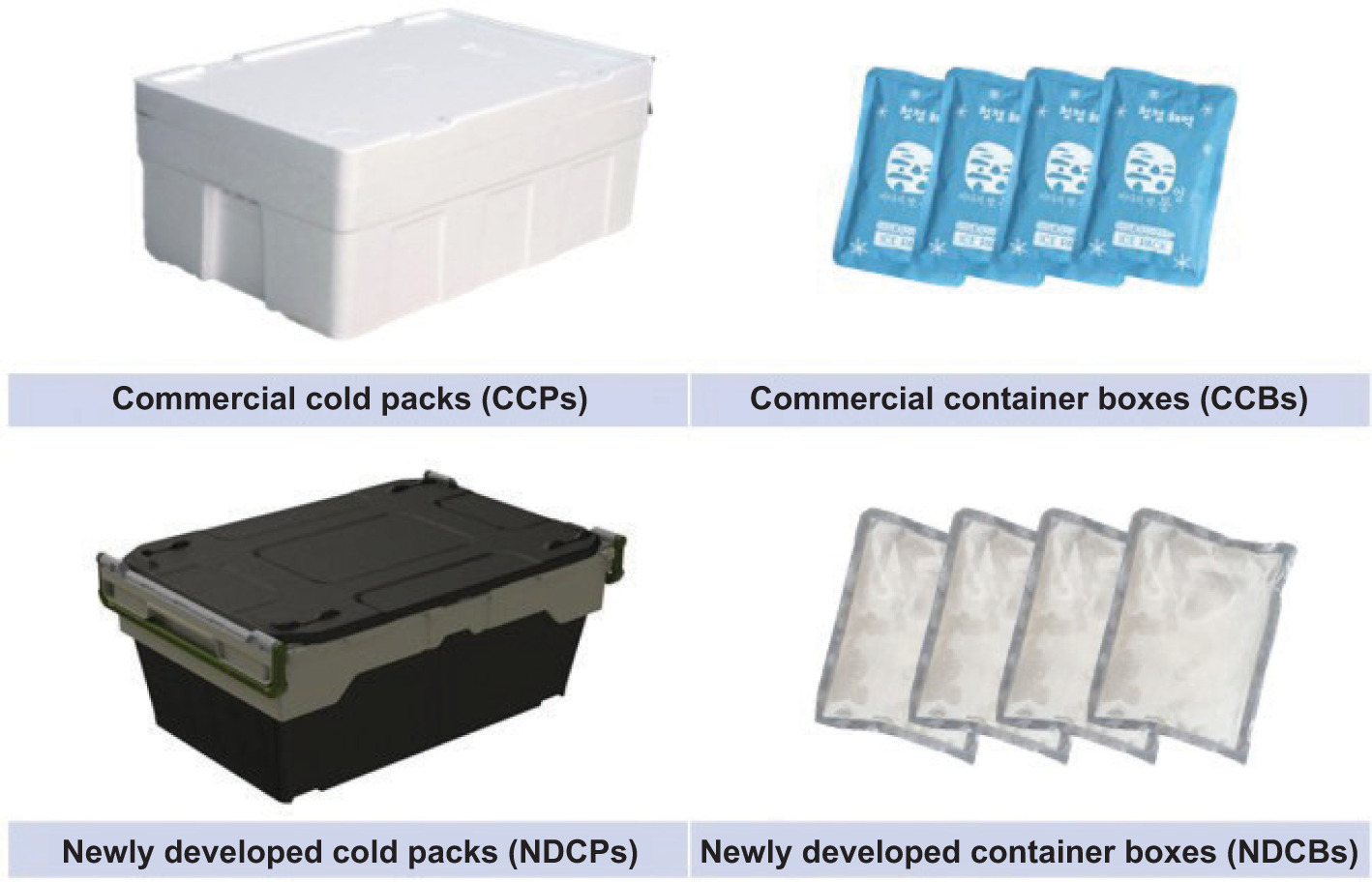
A CCB (polystyrene box; Samil Co. Ltd., Hwaseong, South Korea) was purchased online, and CCPs were prepared from 100% water. The NDCBs were obtained from the National Plastic Company (Seoul, South Korea) and were composed of nylon, EPP, and polypropylene (PP). The NDCPs were supplied by 3AC (Seoul, South Korea) and were formulated with xanthan gum, water, and salt. NDCPs utilize an environment-friendly phase change material (PCM) designed to maintain the freshness of seafood. A schematic diagram of the newly developed container boxes is shown on Figure 1.
Figure 1. Schematic diagrams of conventional cold packs (CCPs), conventional container boxes (CCBs), newly developed cold packs (NDCPs), and newly developed container boxes (NDCBs) used in this study.
Expanded polypropylene, the insulation material used in NDCBs, is produced by adding a blowing agent to PP, forming numerous independent closed cells. These microcellular air pockets serve as effective thermal barriers that minimize heat transfer. The thermal conductivity of EPP ranges from approximately 0.034 to 0.040 W/m•K, which is comparable to that of expanded polystyrene (EPS; 0.032–0.038 W/m•K).
Polypropylene, the primary raw material of NDCBs, is a resin composed of 85.7% carbon (C) and 14.3% hydrogen (H), with a chemical formula C3H6.
Measurement of changes in temperature in CCBs with CCPs and in NDCBs with NDCPs over time
Internal temperatures in CCBs with CCPs and in NDCBs with NDCPs were measured using a wireless temperature logger (EBI 11; Ebro Co., Germany). Four CCPs were placed in CCBs under the same conditions as the NDCBs with NDCPs. Then, the containers were sealed and placed in a static incubator at 26.7 ± 0.5°C for 72 h.
Bacterial inoculation on sample surface
Samples were prepared for L. monocytogenes growth by cutting into 3.0 × 3.0 (length × width) pieces. To eradicate microbial contamination, surfaces of the samples were disinfected with 70% ethanol before inoculation. Subsequently, the samples were thoroughly air-dried to ensure complete evaporation of ethanol prior to inoculation. The control samples were not inoculated with L. monocytogenes.
The ATCC 19113 and ATCC 19117 strains of L. monocytogenes were used in these experiments. The stock cultures were stored at –80°C in tryptic soy broth (TSB; Difco Laboratories, Detroit, MI, USA) containing 30% glycerol. Each strain (10 μL) was incubated in 5 mL of TSB at 30% for 24 h, after which centrifugation was performed at 5,400 rpm for 10 min at 4°C (SUPRA22K; Hanil Science Industrial Co., Daejeon, South Korea). This process was repeated twice to induce bacterial activation. The obtained pellets were resuspended in 9 mL of sterilized NaCl solution (0.85%), and L. monocytogenes was mixed with each pellet.
The mackerel fillet samples were contaminated with L. monocytogenes via spot inoculation, with approximately 100 μL of bacterial strain used for each spot. After inoculation, the samples were left in a biological safety cabinet (CHC Lab Co. Ltd., Daejeon, South Korea) for 1 h to absorb L. monocytogenes. The initial concentration of activated L. monocytogenes was approximately 2.0–2.5 log CFU/g, which was within the range commonly used in previous studies to simulate low-level contamination in seafood products (Li et al., 2025).
Experiment conditions and bacterial analysis
The storage temperature of samples was set by referring to the recent average temperature of 26.7°C in August in South Korea (Korea Meteorological Administration [KMA], 2023). The experimental period ranged from 2 to 72 h, which is the typical duration of home delivery. Each frozen mackerel fillet was sealed in a CCB with CCP and in an NDCB with NDCP. Three samples were analyzed per experiment, and each experiment was conducted twice. The temperature was adjusted and monitored periodically using thermometers inside and outside the refrigerator.
Samples in CCBs with CCPs and in NDCBs with NDCPs were placed in sterile bags (Labplus Inc., Sainte-Julie, Quebec, Canada), diluted 10-fold with 0.85% sterile NaCl solution, and homogenized using a stomper (Easy Mix; AES Chemunex, Rennes, France). Subsequently, the homogenized solution was diluted serially. The diluted samples (1 mL) were pour-plated in duplicate on tryptic soy agar (Difco Laboratories) and incubated at 30°C for 48 h.
Modeling of microbial growth during a storage period of 24–72 h
The increase in microbial contaminants in frozen mackerel fillets stored in CCBs with CCPs and in NDCBs with NDCPs was modeled using first-order kinetics as follows:
where
-
N0 is the initial microbial population (CFU);
-
N represents the microbial population (CFU) in CCBs with CCPs or NDCBs with NDCPs at time t;
-
t is the exposure time (h); and
-
k is the growth rate constant.
This first-order kinetic model assumes that microbial growth rate is proportional to the current population, and that environment conditions, such as temperature and packaging, remain constant during storage. Consequently, microbial increase can be characterized by a single rate constant k or its reciprocal, the D-value, which provides a quantitative measure of resistance to an applied lethal agent. The D-value, representing the time required for a 1-log (decimal) increase in microbial population, is calculated as D = 2.303/k.
Statistical analysis
The results are presented as the mean of three replicates ± standard deviation (SD). One-way analysis of variance was performed using the SPSS software. All experiments were analyzed using Duncan’s multiple range test to identify differences in mean values. Statistically significant difference was tested at a 5% probability level (P < 0.05).
Results and Discussion
Growth patterns of L. monocytogenes in CCBs with CCPs and in NDCBs with NDCPs
Global fish production has exhibited consistent and sustained growth over the past five decades, with the food fish supply increasing at an average annual rate of 3.2% (Food and Agriculture Organization [FAO], 2014). In South Korea, mackerel (S. japonicus) is the most popular fish, with a mean consumption of 3.25 g per capita per day (Korea Health Industry Development Institute, 2020). Fish, particularly if sold in fresh form, has gained popularity because of its convenience for preparation and cooking. However, its high moisture content, near-neutral postmortem pH, and abundance of low-molecular-weight compounds, such as free amino acids, make it highly susceptible to microbial growth and oxidative deterioration (Amaral et al., 2021). Consequently, unexpected fluctuations in temperature or interruptions in food cold chain can negatively affect the safety and quality of food supply chain, resulting in consumer distrust and increased generation of food waste. Seafood is typically store-refrigerated or frozen until purchase, and temperature is controlled through the provision of Styrofoam boxes or ice boxes. However, information regarding temperature control measures employed during the transportation phase is lacking. Fresh raw fish must be handled and distributed correctly during summer when the temperature inside delivery vehicles rises significantly.
Listeriosis is a relatively uncommon but potentially severe foodborne disease with a high incidence of hospitalization and mortality. The causative pathogen, L. monocytogenes, has the potential to contaminate foodstuffs through exposure to environmental sources or cross-contamination. RTE food products are identified as having the highest risk, as their processing and retail stages have the highest level of noncompliance (EFSA and ECDC, 2017). The recommended practices for preserving these foods relate to the use of cold storage (US Food and Drug Administration [FDA], 2017); however, L. monocytogenes can grow at temperatures of 0–45°C, indicating a need for a more comprehensive approach for food conservation of RTE foods (UK Health Protection Agency, 2009). Therefore, in some instances, safety of the prepared food products cannot be guaranteed by the use of cold storage temperatures. As stated by Wu (2008), damaged cells are equally important as undamaged bacteria, as they are resuscitated and subsequently resume normal growth.
The NDCP used in this study was formulated with food-grade inorganic salts and xanthan gum, a natural polysaccharide widely used as a stabilizer, thickener, and emulsifier. This composition mimics the thermal properties of seawater, allowing for effective temperature regulation during transportation and storage of seafood products. Compared with conventional polymer-based cold packs, these biopolymer-based PCM packs are biodegradable, nontoxic, and environment-compatible, reducing both carbon footprint and potential environmental contamination (Perera et al., 2023). The NDCBs are constructed using thermoplastic resins, including PP and EPP. Because PP and EPP share the same chemical composition, the assembled containers can be remelted and recycled, supporting circular economy practices (Agarwal et al., 2023). However, both PP and EPP are non-biodegradable materials and can take hundreds of years to decompose under natural environmental conditions, highlighting the importance of recycling and reuse to minimize environmental impact. A comparison of environmental impact and cost of CCBs and NDCBs is summarized in Table 1.
Table 1. Comparison of environmental impact and costs of conventional container boxes (CCBs) and newly developed container boxes (NDCBs).
| Category | EPS (CCBs) | EPP (NDCBs) |
|---|---|---|
| Recyclability | Made of thermosetting resin; limited recyclability | Made of thermoplastic resins; recyclable |
| Durability | Fragile; easily broken | Excellent resistance to impact and deformation |
| Lifetime/reuse | Single use | Long-term use; reusable for up to ~100 times |
| Disposal/environmental impact | Large volume; difficult to recycle; may cause environmental pollution | Recyclable; reduced landfill, and incineration |
| Unit cost | ~4,000 KRW | ~20,000 KRW |
| Reuse count | ~1 Time | ~100 Times |
| Cost per use | ~4,000 KRW | ~200 KRW |
Notes: EPS: expanded polystyrene; EPP: expanded polypropylene; KRW: South Korean Won (official currency of South Korea).
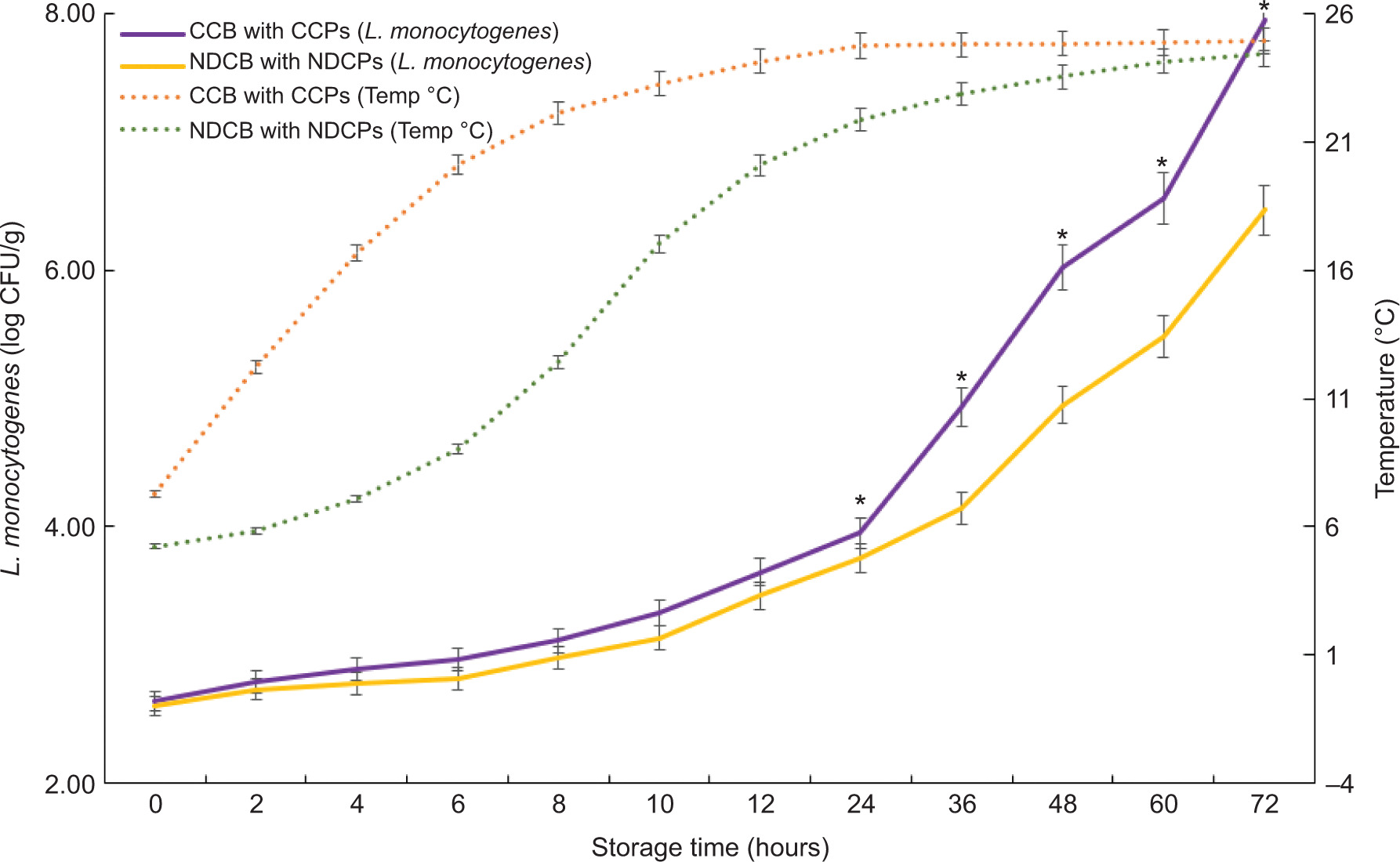
This study aimed to investigate the growth patterns of L. monocytogenes in CCBs with CCPs and in NDCBs with NDCPs. To reduce background microbial contamination, ethanol was applied to the surface of fish samples prior to the inoculation of L. monocytogenes. However, residual ethanol on the sample surface could potentially inhibit bacterial growth by extending the lag phase or reducing the growth rate, thereby affecting the interpretation of results. To minimize this risk, the samples were allowed to air-dry completely to ensure that the ethanol was fully evaporated before inoculation. The growth of L. monocytogenes increased significantly (P < 0.05) during storage for 3 days (2–72 h) in CCBs with CCPs and in NDCBs with NDCPs (Figure 2). In CCBs with CCPs, the L. monocytogenes count was initially recorded at 2.64 log CFU/g. The range observed for storage time of 2–24 h was 2.79–3.95 log CFU/g, representing an increase of 1.16 log CFU/g. Subsequently, the count notably increased from 36 h of storage to the final 72 h, reaching 4.94, 6.02, 6.56, and 7.95 log CFU/g.
Figure 2. Growth patterns of Listeria monocytogenes in frozen mackerel fillets during 3 days of storage. Two packaging systems were compared: a conventional cold box with conventional cold packs (CCBs with CCPs) and a newly developed cold box with newly developed cold packs (NDCBs with NDCPs). * indicates a significant difference between two packaging systems (t-test, P < 0.05) during storage from 24 to 72 h.
Meanwhile, in NDCBs with NDCPs, the growth rate was 2.64 log CFU/g, indicating an increase of 1.02 log CFU/g after 24 h of storage. This further increased by 1.41, 2.22, 2.75, and 3.74 log CFU/g from 36 h to 72 h of storage. The mean difference between CCBs with CCPs and NDCBs with NDCPs was 0.20 log CFU/g (equivalent to [0.04+0.07+0.11+0.15+0.26+0.20+0.19+0.20]/6) over 24 h of storage. After 48 h of storage, a difference of approximately 1 log CFU/g was observed between CCBs with CCPs and NDCBs with NDCPs. After 72 h, the difference increased to 1.48 log CFU/g. Although the first-order kinetic modeling (see Section 2.5. Experiment conditions and bacterial analysis) assumed constant temperature, the internal temperatures of CCBs with CCPs and NDCBs with NDCPs varied slightly during storage. Nevertheless, the model was applied primarily to compare the relative efficacy of the two packaging systems, rather than to obtain absolute growth predictions. Therefore, despite temperature fluctuations, the model provided meaningful insights into the comparative performance of CCBs with CCPs and NDCBs with NDCPs in controlling L. monocytogenes growth. Although some bacteria can produce cold-shock proteins to grow at lower temperatures, their adaptation process is slow and not conducive to rapid growth. Immediate drop in temperature in NDCBs with NDCPs did not allow adequate time for the bacteria to adapt, resulting in an extended lag phase, rather than immediate proliferation.
Under cold conditions, key enzymatic processes related to nutrient uptake and DNA replication operate less efficiently, further suppressing bacterial growth and division. Collectively, these physiological responses help to explain delayed growth behavior observed under improved thermal control conditions. In this context, the present study focused on microbial behavior and thermal performance to evaluate the food safety implications of different cold-pack systems. Accordingly, sensory and general quality parameters, such as texture, drip loss, and color, were not included. While microbial safety represents a fundamental prerequisite in seafood logistics, future studies integrating sensory and physicochemical quality assessments are necessary to evaluate fully the practical suitability of cold-pack systems.
In this study, the internal temperatures of CCBs with CCPs and NDCBs with NDCPs were measured. Table 2 presents the temperatures recorded at 2-h intervals during 72 h of storage at approximately 26.7 ± 0.5°C. The initial internal temperatures were 7.29°C for CCBs with CCPs and 5.23°C for NDCBs with NDCPs. Although frozen fillets were used, these initial temperatures reflect realistic shipping conditions: when fillets are placed in a styrofoam box with cold packs and sealed, the internal temperature of the box does not start at 0°C. It should be noted that the temperatures reported in this study correspond to the internal air temperature within the container rather than the core temperature of fish fillets. In general, the core temperature of frozen fish changes more slowly and is expected to remain lower than the surrounding air temperature because of its higher thermal mass. For CCBs with CCPs, the internal temperature increased by approximately 4°C after 2 h, reaching 12.24°C, and further increased to 9.38°C, 12.83°C, and 14.85°C at 4, 6, and 8 h, respectively. From 24 to 72 h, the temperature remained relatively stable between 24.77°C and 24.92°C (P > 0.05).
In contrast, NDCBs with NDCPs exhibited an initial lower temperature of 5.23°C, which gradually increased to 5.83°C, 7.09°C, and 9.03°C after 2, 4, and 6 h, respectively. After 8 h, the temperature reached 12.43°C, similar to the 2-h temperature of CCBs with CCPs. The temperature continued to rise, reaching 24.46°C at 72 h, approximately 0.5°C lower than that of CCBs with CCPs. These results suggest that NDCBs with NDCPs possess excellent moisture and thermal barrier properties, allowing them to maintain lower internal temperatures for extended periods. Such an environment inhibits bacterial growth, particularly of pathogenic bacteria, and indicates that NDCBs with NDCPs could be effectively used for the storage and transport of seafood, especially when combined with other preservation methods.
Table 2. Comparison of changes in temperature in a conventional cold box with conventional cold packs (CCB with CCPs) and a newly developed cold box (NDCB) with newly developed cold packs (NDCBs with NDCPs) during 3 days of storage.
| Time (h) |
Temperature (c) | |
|---|---|---|
| CCBs with CCPs | NDCBs with NDCPs | |
| 0 | 7.29 ± 0.17h,A | 5.23 ± 0.05l,B |
| 2 | 12.24 ± 0.12g,A | 5.83 ± 0.15k,B |
| 4 | 16.67 ± 0.05f,A | 7.09 ± 0.15j,B |
| 6 | 20.12 ± 0.11e,A | 9.03 ± 0.09i,B |
| 8 | 22.14 ± 0.15d,b,A | 12.43 ± 0.12h,B |
| 10 | 23.26 ± 0.12c,b,A | 17.05 ± 0.10g,B |
| 12 | 24.16 ± 0.12b,A | 20.10 ± 0.12f,B |
| 24 | 24.77 ± 0.15a,A | 21.85 ± 0.12e,B |
| 36 | 24.79 ± 0.08a,A | 22.88 ± 0.08d,B |
| 48 | 24.85 ± 0.15a,A | 23.55 ± 0.09c,B |
| 60 | 24.91 ± 0.16a,A | 24.15 ± 0.05b,B |
| 72 | 24.95 ± 0.14a,A | 24.46 ± 0.14a,B |
Notes: Two packaging systems were compared: CCBs with CCPs and NDCBs with NDCPs.
The data indicate mean values with standard deviations (three samples/treatment).
Within the same column, mean values with different superscript alphabets (a–h) for CCBs with CCPs and (a–l) for NDCB with NDCPs differ significantly (P < 0.05) by Duncan’s multiple range test.
Values with different superscript alphabets in the same row are significantly different (P < 0.05) by t-test.
This was correlated with studies conducted by Park et al. (2020), wherein changes were examined in the internal temperature of paper boxes, aluminum film-coated boxes, and Styrofoam boxes (condition: 27.7°C). The authors measured the change in temperature after 3 h and found that the temperature in paper boxes increased from an initial 22.8°C to 28.4°C, and that in aluminum film-coated boxes, it increased from 21.7°C to 23.1°C, whereas that in the styrofoam boxes the temperature decreased from 19.8°C to 17.4°C. Notably, the results may vary depending on several factors, including shape of the sample, material of the shipping container, and the number of ice packs used. According to FDA (2021) and EFSA (2015) cold-chain standards, refrigerated seafood should be maintained at 0–5°C and frozen seafood at below –18°C during storage and transportation.
From an industrial perspective, the practical implementation of NDCBs with NDCPs would require integration with the existing cold-chain management practices, including routine temperature monitoring, data logging, and compliance with international food safety standards, such as those established by both FDA and EFSA. Continuous or time–temperature monitoring is particularly important to verify that critical temperature thresholds are maintained throughout storage and distribution. Although the internal temperatures of both systems increased gradually during storage, NDCBs with NDCPs exhibited a slower increase in temperature and superior insulation performance, suggesting its potential for compliance with international cold-chain requirements and practical applicability in seafood logistics.
It should be noted that the temperatures measured in this study represent internal air temperatures inside container boxes, and tend to be higher than the core temperature of the seafood itself. If the core temperature of fish fillets were measured directly, lower temperature would be probably observed. In this study, we developed an eco-friendly refrigerant pack (NDCPs) and an insulated container (NDCBs) as sustainable alternatives to conventional cooling systems. The NDCBs were fabricated using PP and EPP, both of which exhibit superior mechanical and thermal properties. PP is widely applied in various consumer and industrial products because of its ease of cleaning, reusability, and high rigidity even at reduced thickness. In addition, EPP provided enhanced thermal insulation and cushioning capacity without generating debris during usage, thereby overcoming the well-known limitations of EPS. These material advantages enable the container to be reused and recycled, highlighting its eco-friendly characteristics.
Furthermore, NDCPs were formulated with xanthan gum, water, and salt, which are nontoxic and biodegradable, offering a safer and more sustainable substitute for petroleum-based refrigerant gels. Taken together, the developed system demonstrates the potential to address the environmental concerns associated with disposable refrigerants and polystyrene containers while maintaining practicality and functional efficiency. In addition, the experimental setup was designed to enable a controlled comparison of packaging systems and therefore did not simulate certain real-world distribution factors, such as repeated door openings, handling-induced vibrations, or transportation dynamics. While this controlled approach allowed for a reproducible evaluation of thermal performance and microbial response, it may not fully capture the variability and complexity of conventional cold-chain environments. Accordingly, future studies incorporating dynamic temperature fluctuations, mechanical stress, or field-based distribution trials are warranted to further enhance the applicability of these findings to real-world cold-chain systems.
Recently, owing to the glaring impacts of climate changes, the same-day delivery packaging, increasing direct-to-consumer purchasing models, government and legal regulations, and the global pandemic, people have recognized the negative effects of over-packaging and the continued use of non-recyclable, non-reusable packaging. To mitigate these environmental impacts, the use of NDCBs with NDCPs demonstrated superior thermal performance, compared to CCBs with CCPs, which may reduce environmental contamination. Moreover, the system shows promising future market potential, scalable production capabilities, and the possibility for seamless integration into emerging cold-chain distribution networks.
Effect of CCBs with CCPs and NDCBs with NDCPs on L. monocytogenes in frozen mackerel fillets in terms of D-values
First-order reaction models are used to describe a decline in microbial populations or the kinetics of microbial inactivation. Recent work in predictive microbiology and microbial risk assessment has integrated dynamic temperature profiles and risk modeling tools to better predict the behavior of L. monocytogenes under non-isothermal conditions (Deng et al., 2025; Skandamis et al., 2025). In seafood-specific contexts, Gonzales-Barron et al. (2024b) developed a quantitative risk assessment model for RTE smoked and gravad fish, demonstrating how predictive models can link temperature fluctuations with microbial growth behavior. In comparison, vacuum-packed frozen mackerel stored in NDCBs with NDCPs exhibited slower growth of L. monocytogenes. Reported contamination prevalence is higher in gravad (~52.2% lot contamination) and smoked fish (~34–39%) (Gonzales-Barron et al., 2024b).
In this study, a first-order kinetic model was employed to quantitatively evaluate cooling performance and microbial response during storage. Decimal reduction time (D-value) by first-order kinetics is currently the most widely accepted method for determining the rate of microbial inactivation. Modeling of reduction dynamics provides useful information for quantitative microbial risk assessment. It also provides a tool to compare the importance of different process technologies for reducing microbial population (Berk, 2018). Thus, the first-order kinetic model was used to fit the growth curve of L. monocytogenes in frozen mackerel fillets stored in CCBs with CCPs and in NDCBs with NDCPs (Equation 1, Section 2.6.). The experimental data obtained were analyzed in a linear form from 24 h to 72 h of storage and are presented in Table 3.
Table 3. D-values representing the time required for Listeria monocytogenes growth in frozen mackerel fillets stored in a conventional cold box with conventional cold packs (CCBs with CCPs) and a newly developed cold box with newly developed cold packs (NDCBs with NDCPs) during 3 days of storage (24–72 h).
| Equation of the first-order kinetic model | ||
|---|---|---|
| CCBs with CCPs | y = ax + b | y = 0.0802x + 0.3127 |
| Correlation coefficient (R2) | 0.99 | |
| D-value (h) of storage time | 36.47 ± 0.04b | |
| NDCBs with NDCPs | y = ax + b | y = 0.0565x + 0.1400 |
| Correlation coefficient (R2) | 0.98 | |
| D-value (h) of storage time | 41.70 ± 0.06a | |
Note: Two packaging systems were compared: CCBs with CCPs and NDCBs with NDCPs.
D-value: Decimal reduction time represents the time required for a 1-log (decimal) increase in microbial population.
Different superscript alphabets in a column (a–b) are significant differences by one-way ANOVA performed by t-test with 5% probability.
Correlation coefficient (R2) of determination closer to 1 implies that the reduction patterns are well explained using the first-order kinetics. All R2 values were close to 1.0 (0.99 for CCBs with CCPs, and 0.98 for NDCBs with NDCPs), confirming that the model had a very good fit for growth curves. Residuals between observed and predicted values were generally small across all time points (±0.2 log CFU), indicating that the first-order model accurately described growth of L. monocytogenes under both storage conditions. In this study, the 90% reduction time (D-value) for growth in CCBs with CCPs and in NDCBs with NDCPs was 36.47 and 41.70 min, respectively.
Despite the high fit of the first-order model to the observed data, this study was limited to frozen mackerel fillets under specific cold-pack and container conditions. The applicability of the model to other fish species, storage temperatures, or commercial-scale processes has not been validated. Additionally, only the first-order kinetic model was applied, which may not fully capture more complex microbial growth patterns. These limitations should be considered when interpreting the results and applying them to seafood safety management. In future research, regression-based predictive models could be incorporated to describe L. monocytogenes growth as a function of temperature and time under fluctuating storage conditions (Baranyi and Roberts, 1994). Establishing such quantitative relationships between internal temperature profiles and microbial growth rates would enable the more accurate prediction of microbial risks associated with varying cooling performances of different containers.
The experimental scope of this study was limited to vacuum-packed frozen mackerel (Scomber japonicus) fillets under specific container and cold-pack conditions; therefore, the findings may not be directly extrapolated to other seafood species, processing types, or storage scenarios. In addition, the experiments were conducted under controlled laboratory conditions, which may not fully represent the variability and complexity of commercial cold-chain systems. Finally, although the first-order kinetic model provided a good fit to the observed data, it may not capture more complex microbial growth behaviors under non-isothermal conditions, and caution is required when applying these results to commercial cold-chain settings.
Conclusions
This study demonstrated that maintaining cold temperatures effectively reduced the growth of L. monocytogenes in vacuum-packed frozen mackerel fillets stored in NDCBs with NDCPs, compared to CCBs with CCPs. After 48 h of storage, a difference of approximately 1 log CFU/g was observed between the two packaging systems, which increased to 1.48 log CFU/g after 72 h. A first-order kinetic model applied to storage periods from 24 h to 72 h showed 90% D-values of 36.47 ± 0.04 min for CCBs with CCPs and 41.70 ± 0.06 min for NDCBs with NDCPs, demonstrating the model’s effectiveness in assessing microbial growth under different cold-chain conditions. Temperature control during transport is a critical determinant of food safety and quality, as fluctuations can significantly influence microbial behavior and product’s shelf life. Accordingly, the use of NDCBs with NDCPs in real-scale transport may suppress the growth of L. monocytogenes by minimizing temperature variability during distribution, thereby contributing to the extension of frozen fish’s shelf life and the delivery of high-quality products. The novelty of this study does not lie in the use of cold packs, but in the comparative microbial risk assessment of eco-designed cold-chain systems under real-scale transport conditions. By quantitatively linking temperature control performance with growth kinetics of L. monocytogenes, this study provides new insights into the food safety implications of sustainable cold-chain design.
Mandatory Disclosure on Use of Artificial Intelligence
The authors declare that no AI-assisted tools were used in the preparation of this manuscript. All references have been manually verified for accuracy and relevance
Data Availability Statement
All data generated or analyzed in this study are included in this published article.
Author Contributions
Eun Bi Jeon: data curation, investigation, writing – original draft; Jin Kim, Ahreum Chae, Sungwon Hong, and Inhwan Song: methodology; Jung-Suck Lee and Shin Young Park: writing – review & editing and funding. All authors had read and agreed to the published version of the manuscript.
Conflict of Interest
The authors declared no conflict of interest.
Funding
This research was a part of the project titled ‘Development to solve current issues in seafood distribution’ (RS-2021-KS11537), funded by the Ministry of Oceans and Fisheries, South Korea.
REFERENCES
Agarwal, A., Shaida, B., Rastogi, M., and Singh, N.B. 2023. Food packaging materials with special reference to biopolymers—properties and applications. Chemistry Africa 6: 117–144. 10.1007/s42250-022-00446-w
Amaral, R.A., Pinto, C.A., Lima, V., Tavares, J., Martins, A.P., Fidalgo, L.G., Silva, A.M., Gil, M.M., Teixeira, P., Barbosa, J., Barba, F.J., and Saraiva, J.A. 2021. Chemical-based methodologies to extend the shelf life of fresh fish—a review. Foods 10(10): 2300. 10.3390/foods10102300
Baranyi, J., and Roberts, T.A. 1994. A dynamic approach to predicting bacterial growth in food. International Journal of Food Microbiology 23(3–4): 277–294. 10.1016/0168-1605(94)90157-0
Barnes, D., Galgani, F., Thompson, R., and Barlaz, M. 2009. Accumulation and fragmentation of plastic debris in global environments. Philosophical Transactions of the Royal Society B: Biological Sciences 364(1526): 1985–1998. 10.1098/rstb.2008.0205
Berk, Z. 2018. Food Process Engineering and Technology, 3rd ed. Academic Press, Cambridge, MA, pp. 79–126 and 399–438.
Choi, M.H., Park, Y.J., Kim, M., Seo, Y.H., Kim, Y.A., Choi, J.Y., Yong, D., Jeong, S.H., and Lee, K. 2018. Increasing incidence of listeriosis and infection-associated clinical outcomes. Annals of Laboratory Medicine 38(2): 102–109. 10.3343/alm.2018.38.2.102
Cropotova, J., Mozuraityte, R., Standal, I.B., and Rustad, T. 2019. Assessment of lipid oxidation in Atlantic mackerel (Scomber scombrus) subjected to different antioxidant and sous-vide cooking treatments by conventional and fluorescence microscopy methods. Food Control 104: 1–8. 10.1016/j.foodcont.2019.04.016
Deng, Z., Li, W., Song, Y., Wen, H., Zhang, Y., Du, Y., Wang, Y., Huang, C., and Chen, J. 2025. Assessing the growth dynamics of Listeria monocytogenes and microbiota in RTE poultry: a combined BP-ANN and traditional approach. International Journal of Food Microbiology 438: 111221. 10.1016/j.ijfoodmicro.2025.111221
European Commission. 2025a. Packaging and packaging waste regulation (PPWR). Available at: https://environment.ec.europa.eu/topics/waste-and-recycling/packaging-waste_en (Accessed: 15 January 2025).
European Commission. 2025b. Circular Economy – Environment. Available at: https://environment.ec.europa.eu/strategy/circular-economy_en (Accessed: 24 January 2025).
European Food Safety Authority (EFSA). 2015. Scientific opinion on the evaluation of the temperature to be applied in the fish distribution chain. EFSA Journal 13(7): 4162. Available at: 10.2903/j.efsa.2015.4162 (Accessed: 18 January 2025).
European Food Safety Authority (EFSA) and European Centre for Disease Prevention and Control (ECDC). 2017. The European Union summary report on trends and sources of zoonoses, zoonotic agents and food-borne outbreaks in 2016. EFSA Journal 15(12): 5077.
European Food Safety Authority (EFSA) and European Centre for Disease Prevention and Control (ECDC). 2023. The European Union One Health 2022 Zoonoses Report. EFSA Journal 21: e8442.
Food and Agriculture Organization (FAO). 2014. The State of World Fisheries and Aquaculture: Opportunities and Challenges. FAO, Rome, Italy, 243 p. Available at: http://www.fao.org/3/a-i3720e.pdf (Accessed: 15 March 2025).
Foucat, L., Taylor, R.G., Labas, R., and Renou, J.P. 2001. Characterization of frozen fish by NMR imaging and histology. American Laboratory 33(16): 38–43.
Gambarin, P., Magnabosco, C., Losio, M.N., Pavoni, E., Gattuso, A., Arcangeli, G., and Favretti, M. 2012. Listeria monocytogenes in ready-to-eat seafood and potential hazards for the consumers. International Journal of Microbiology 2012: 497635. 10.1155/2012/497635
Goja, A.M., Ahmed, T.A.A., Saeed, S.A.M., and Dirar, H.A. (2016). The cold chain—transport, storage, retail. In: Hundy, G.F., Trott, A.R., and Welch, T.C. (eds.), Refrigeration, Air Conditioning and Heat Pumps, 5th ed. Butterworth-Heinemann, Oxford, UK, pp. 273–287.
Gonzales-Barron, U., Cadavez, V., Mota, J.O., Guillier, L., and Sanaa, M. 2024a. A critical review of risk assessment models for Listeria monocytogenes in seafood. Foods 13(5): 716. 10.3390/foods13050716
Gonzales-Barron, U., Pouillot, R., Skjerdal, T., Carrasco, E., Teixeira, P., Stasiewicz, M.J., Hasegawa, A., De Oliveira Mota, J., Guillier, L., Cadavez, V., and Sanaa, M. 2024b. A quantitative risk assessment model for Listeria monocytogenes in ready-to-eat smoked and gravad fish. Foods 13(23): 3831. 10.3390/foods13233831
Hussain, S., Akhter, R., and Maktedar, S.S. 2024. Advancements in sustainable food packaging: from eco-friendly materials to innovative technologies. Sustainable Food Technology 2(5): 1297–1364. 10.1039/d4fb00084f
Korea Health Industry Development Institute. 2020. National food & nutrition statistics 2013. Available at: https://faolex.fao.org/docs/pdf/sam158398.pdf (Accessed: 11 March 2025).
Korea Meteorological Administration (KMA). 2023. Average temperature for the last 30 years in Korea. Available at: https://www.weather.go.kr/w/index.do (Accessed: 19 March 2025)
Lambrechts, K., and Rip, D. 2024. Listeria monocytogenes in the seafood industry: exploring contamination sources, outbreaks, antibiotic susceptibility, and genetic diversity. Microbiology Open 13: e003. 10.1002/mbo3.70003
Li, W., Wang, Q., Deng, Z., Du, Y., Song, Y., Xu, T., Shan, L., and Chen, J. 2025. Integrating kinetic models and BP-ANN for predicting growth and shelf-life of Listeria monocytogenes in ready-to-eat salads. Food Science and Technology (LWT) 221: 117607. 10.1016/j.lwt.2025.117607
Nam, J.W., Oh, S.R., Koh, H.B., Won, S.H., Jung, M.J., Han, A.R., Kim, B.M., and Jun, J.W. 2022. Changes in the physicochemical properties of olive flounder (Paralichthys olivaceus) fillets during storage in a high-voltage electrostatic field-refrigeration system. Korean Journal of Food Preservation 29(6): 884–894. 10.11002/kjfp.2022.29.6.884
Novoslavskij, A., Terentjeva, M., Eizenberga, I., Valciņa, O., Bartkevičs, V., and Bērziņš, A. 2016. Major foodborne pathogens in fish and fish products: a review. Annals of Microbiology 66: 1–15. 10.1007/s13213-015-1102-5
Park, H.J., Lee, J.E., Kim, S.A., and Shim, W.B. 2020. Changes in internal and external temperature and microbiological contamination depending on consumer behavior after purchase of fresh-cut produces. Journal of Food Hygiene and Safety 35(5): 459–467. 10.13103/JFHS.2020.35.5.459
Perera, K.Y., Jaiswal, A.K., and Jaiswal, S. 2023. Biopolymer-based sustainable food packaging materials: challenges, solutions, and applications. Foods 12(12): 2422. 10.3390/foods12122422
Sheng, L., and Wang, L. 2021. The microbial safety of fish and fish products: recent advances in understanding its significance, contamination sources, and control strategies. Comprehensive Reviews in Food Science and Food Safety 20(1): 738–786. 10.1111/1541-4337.12671
Skandamis, P.N. 2025. “Growth predictor”: a new predictive modelling and quantitative microbial risk assessment tool. Food Research International 209: 116329. 10.1016/j.foodres.2025.116329
Song, E.J., Kim, J.Y., Lee, S.Y., Kim, K.B.W.R., Kim, S.J., and Yoon, S.Y. 2009. Effect of roasted ground coffee residue extract on shelf-life and quality of salted mackerel. Journal of the Korean Society of Food Science and Nutrition 38(6): 780–786. 10.3746/jkfn.2009.38.6.780
Tiensuu, T., Guerreiro, D.N., Oliveira, A.H., O’Byrne, C., and Johansson, J. 2019. Flick of a switch: regulatory mechanisms allowing Listeria monocytogenes to transition from a saprophyte to a killer. Microbiology 165(8): 819–833. 10.1099/mic.0.000808
U.S. Food and Drug Administration (FDA). (2017). Draft guidance for industry: Control of Listeria monocytogenes in ready-to-eat foods. U.S. Department of Health and Human Services. Available at: https://www.fda.gov/media/102633/download (Accessed: 4 February 2026).
US Food and Drug Administration (FDA). 2021. Fish and Fishery Products Hazards and Controls Guidance, 4th ed. US Department of Health and Human Services, Washington, DC. Available at: https://www.fda.gov/food/seafood-guidance-documents-regulatory-information/fish-and-fishery-products-hazards-and-controls (Accessed: 1 February 2025).
UK Health Protection Agency. 2009. Ready-to-eat foods: microbiological safety assessment guidelines. Available at: https://www.gov.uk/government/publications/ready-to-eat-foods-microbiological-safety-assessment-guidelines (Accessed: 4 February 2025).
World Health Organization (WHO). 2007. Food safety issues associated with products from aquaculture. Technical Report Series No. 883. WHO, Geneva, Switzerland.
Wu, V.C.H. 2008. A review of microbial injury and recovery methods in food. Food Microbiology 25(6): 735–744. 10.1016/j.fm.2008.04.011