
Download
D i e t a r y exposure μ g / k g b . w . = C o n s u m p a t i o n g o f food × o c c u r r e n c e μ g / k g of food B o d y w e i g h t k g E q .1 C D I = C × I R i × E F i B W × A T E q .2 T H Q = C D I R f D E q .3 I L C R = C D I × C S F E q .4
Original Article
Assessment of acrylamide in potato fries, chicken, and bread products in major cities of Pakistan during 2024 and estimation of dietary intake
Arfa Liaquat1, Ghulam Mustafa Kamal1, Shahzad Zafar Iqbal2*
1Institute of Chemistry, Khwaja Fareed University of Engineering & Information Technology, Rahim Yar Khan, 64200, Pakistan;
2Food Safety and Toxicology lab, Department of Applied Chemistry, Government College University Faisalabad, 38000, Pakistan
Abstract
Acrylamide is a toxin produced when food is heated at or above 120°C. It is a byproduct of heat processing. Acrylamide is produced in foods rich in carbohydrates and starch during roasting, baking, and frying. It is a carcinogen and also has other health hazards for human beings. Therefore, to check the presence and amount of acrylamide in food, multiple samples of chicken, bread, and potato products were collected from different cities in Pakistan and analyzed by using HPLC. We found acrylamide in almost all samples analyzed. The average amounts 129.07 µg/kg in chicken, 478.85 µg/kg in potatoes, and 112.6 µg/kg in bread samples, with relative standard deviations (RSDs) of less than 7%. The results showed that acrylamide levels differ significantly across food types and sampling areas. The acrylamide exposure rate (µg/kg body weight (BW)) for various age groups was also studied. Although the results suggest that these items may add to total acrylamide intake, it is important to use existing risk assessment frameworks and total dietary exposure when interpreting the observed amounts. Further thorough nutritional and toxicological evaluations are required to more precisely identify the associated health concerns for the Pakistani population, even though the presence of acrylamide merits consideration due to its possible health implications.
Key words: Acrylamide, Potato, Chicken, Bread products, Dietary intake evaluation, Cancer risk assessment
*Corresponding Author: Shahzad Zafar Iqbal, Food Safety and Toxicology lab, Department of Applied Chemistry, Government College University Faisalabad, 38000, Pakistan. Email: [email protected]
Academic Editor: Beraat Özçelik, PhD, Food Engineering Department, Chemical and Metallurgical Faculty, İstanbul Technical University, 34469 Sarıyer/İstanbul, Turkiye
Received: 30 January 2025; Accepted: 25 March 2026; Published: 11 May 2026
© 2026 Codon Publications
This is an Open Access article distributed under the terms of the Creative Commons Attribution-NonCommercial-ShareAlike 4.0 International (CC BY-NC-SA 4.0). License (http://creativecommons.org/licenses/by-nc-sa/4.0/)
Introduction
Acrylamide is not a natural food component, but it is -produced in foods as a byproduct of heat processing. The most popular and one of the oldest methods for food preparation/processing is deep-fat frying at both internal and industrial sites (Bouchon and Dueik 2018; Fikry et al., 2021; Rahman and Malik 2023). It has been found that the Maillard reaction is the primary process of producing acrylamide when food is heated at 120°C or higher temperatures (Koszucka and Nowak 2019; Kumari et al., 2022; Michalak et al., 2020; Pacetti et al., 2015; Pietropaoli et al., 2022; Razia et al., 2016; Sansano et al., 2017; Shahrbabki et al., 2018; Demirok Soncu et al., 2018). This reaction is typically observed in -carbohydrate- and starchy foods during baking, frying, and roasting (Kaur and Halford 2023; Sansano et al., 2017). It gives foods a golden-brown baked color and a delicious taste and smell. Deamination and decarboxylation reactions are the main processes that can lead to the formation of Schiff bases and acrylamides. Cooking conditions, such as water content, temperature, pH, asparagine-reducing sugar contents in the raw materials, and time, affect the formation of acrylamide (Jeong et al., 2020).
Food is a heterogeneous matrix, mainly composed of natural materials and nutritive elements (such as proteins, amino acids, carbohydrates, lipids, fatty acids, vitamins, and moisture content) that can undergo chemical conversion or react with one another during heating and processing. Processing is a thermal process that imparts a pleasant color, flavor, and texture to food, while also removing pollutants. However, it sometimes produces undesirable heat-induced hazardous chemicals in food, such as acrylamide (Perestrelo et al., 2024). The composi tion of food products influences tacrylamid formation, as observed in bread products and potato fries. Higher carbohydrate content, particularly reducing sugars, as well as water -content, time, and temperature of processing, are the factors that contribute to acrylamide production (Khaneghah et al., 2022; Ahmed and Mohammed 2024; Ahmed et al., 2023). Although the role of protein in the formation of acrylamide was unclear, some research indicates that specific amino acids might play a part.
In Asia, it is common practice to reuse cooking oil multiple times to save costs, particularly in roadside food stalls, hotels, and restaurants, without awareness of the detrimental effects of continuous reuse. Commonly consumed foods such as snacks, breakfast items, and fast foods are prepared using repeatedly heated cooking oil (Deshmukh 2019). Lipid oxidation is one of the most common chemical reactions that occur during food preparation and frying, and it can significantly impact food quality (Zhang et al., 2020) and positively affect the production of acrylamide. Despite the absence of reducing sugars, lipid oxidation breakdown products such as aldehydes and ketones could combine with asparagine to generate acrylamide (Hamzalıoğlu and Gökmen 2019).
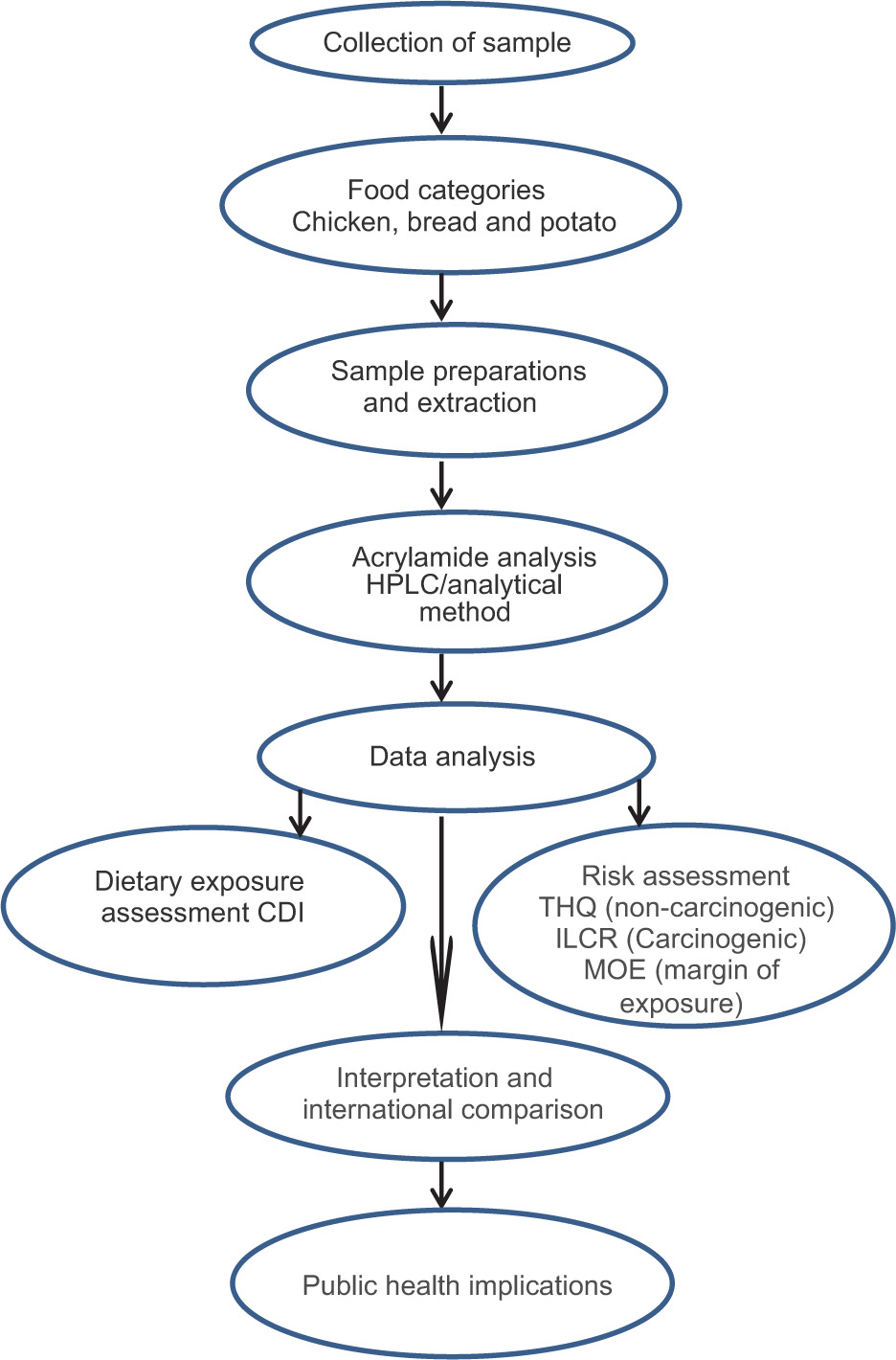
The International Agency for Research on Cancer (IARC) has recognized acrylamide as a potential carcinogen, and validation in animal research has indicated it to be a serious public health hazard (Mucci and Wilson 2008; Naji et al., 2025; Pietropaoli et al., 2022; Tareke et al., 2002). Between 2011 and 2015, the FDA collected approximately 2,500 food product samples to analyze acrylamide levels. Those samples comprised food products known to have higher acrylamide concentrations. Battered and breaded items play a significant role in the processing industry; thus, the choice of components is crucial for minimizing acrylamide formation (Figure 1).
Figure 1. A stepwise flowchart of the study methodology.
Despite international attention on this issue, there is a lack of published data on acrylamide levels in foods consumed in Pakistan. This disparity is particularly noticeable in potato-based products and in fried meat prepared with repeatedly heated cooking oil, a common practice in our country. The public’s health may be at risk due to the incomplete knowledge of the effects of acrylamide. The current study addresses a significant research gap in Pakistan, where there is a lack of information on acrylamide levels in foods. Reusing cooking oil is a common practice in Pakistan; however, its impact on health and the formation of acrylamide remains unclear.
This study excluded raw ingredients (such as uncooked chicken, potatoes, or bread) and packaged foods (including canned, frozen, or processed products). Furthermore, this study calculated Pakistan’s acrylamide dietary intake to provide essential insights for public health initiatives. The findings may serve as a foundation for developing policies and recommendations to reduce acrylamide formation, thereby ensuring the production of safer and higher-quality fried foods for consumers, manufacturers, and regulatory bodies. Therefore, this study aimed to analyze the acrylamide content in foods commonly consumed in Pakistan, including sandwiches, chicken-based items, French fries, potato crisps, chicken nuggets, and bread products, collected from street vendors and restaurants.
Methodology
Sample collection
In the current research, 325 samples containing three important food product categories, including potatoes, chickens, and bread products, from supermarkets and fast-food chains in different cities of Punjab, Pakistan, such as Lahore, Faisalabad, Gojra, and Rahim Yar Khan, were collected during 2024, as shown in Table 1. The selection of cities was made to collect samples from the upper (Lahore), middle (Faisalabad, Gojra), and southern (Rahim Yar Khan) areas of Punjab. After collection, all samples were wrapped in aluminum foil, placed in plastic bags to prevent photodegradation, and transported to the laboratory. The sample was not less than 500 g and kept at −20°C.
Table 1. Number of samples collected in different categories of food products.
| Product category | Food types | No. of samples | Sampling cities(Punjab, Pakistan) |
|---|---|---|---|
| Potato products | Potato chips, potato crisps, French fries, raw potatoes, potato snacks | 108 | Lahore, Faisalabad, Gojra, Rahim Yar Khan |
| Chicken products | Chicken drumsticks, chicken wings, chicken burgers, chicken tandoori, fried chicken, grilled chicken, chicken nuggets | 109 | Lahore, Faisalabad, Gojra, Rahim Yar Khan |
| Bread products | Bread, bread rolls, whole wheat bread, roasted bread, chicken sandwiches, potato sandwiches | 108 | Lahore, Faisalabad, Gojra, Rahim Yar Khan |
| Total | – | 325 | – |
All samples were classified into seven groups based on cooking method, food type, and location. The seven clusters/groups were: Cluster 1: French fries cooked in repeated and fresh oil, Cluster 2: chicken nuggets cooked in fresh oil, Cluster 3: potato crisps cooked in a combination of fresh and repeated oil, Cluster 4: bread cooked in repeated oil, Cluster 5: bread products cooked in fresh oil, Cluster 6: chicken meat–based products cooked in a combination of fresh and repeated oil, and Cluster 7: sandwiches cooked in repeated oil. The sample size for each cluster has been mentioned earlier. This study was wholly based on a randomized design. The samples in this study were collected randomly and allocated to various treatment groups (e.g., raw vs. cooked and different cooking procedures). A random collection of samples helps reduce bias and ensures that the samples are representative of the population.
Chemicals and reagents
Acrylamide and acrylamide-d3 standard were purchased from Sigma Aldrich (Saint Louis, Missouri, USA). HPLC-grade methanol, acetonitrile, and acetone were purchased from Merck (Darmstadt, Germany). Potassium hexacyanoferrate and zinc sulfate were procured from Chem Lab NV (Zedelgem, Belgium). Primary & Secondary Amine, SPE bulk Sorbent were acquired from Sigma-Aldrich (Darmstadt, Germany). To prepare ultrapure water, a water purification system (Econolab, Oklahoma, USA) was used.
Preparation of standard solutions
Stock solutions were diluted to prepare working standard solutions with known concentrations. Stock solutions of the acrylamide standard (10 μg mL-1) were prepared in ultrapure water for spiking. The solutions were prepared (10, 25, 50, 100, 200, 250, 500, 750, and 1000 µg/L), and a calibration curve was constructed with a 5–5000 ng-mL–1 range. One-and-a-half grams of potassium hexacyanoferrate and 3 g of zinc sulfate were dissolved in 10 mL of water to prepare the Carrez I and Carrez II solutions, respectively.
Extraction of acrylamide
The extraction of acrylamide was performed using the method described by Eslamizad et al. (2019). Two grams of sample were taken in a 15-mL centrifuge tube and mixed with 3 mL of methanol. Then, the solution was vortexed for 40 s, and the liquid was centrifuged for 15 min at 4,500 rpm. After centrifuging, 50 μL of Carrez I and Carrez II solutions were added. A vortex shaker was used to shake the tube for 10 s. After adding 50 μL of poly secondary amine, the solution was again vortexed for 10 s and then centrifuged for 15 min at 4500 rpm. Two milliliters of centrifuged solution was taken in a mcrotube, and gently evaporated with nitrogen gas. Then 500 μL of water was added and vortexed for 10s and stored for high performance liquid chromatography (HPLC) analysis.
HPLC conditions
Acrylamide analysis was conducted using a Shimadzu HPLC system (Kyoto, Japan), comprising an LC-20 AD liquid chromatograph, SIL-20A autosampler, CTO-20AC column oven, and SPD-M-20A DAD detector. A gradient flow of mobile phase A (water and 0.1% formic acid) and mobile phase B (methanol with 0.1% formic acid) was used with a flow rate of 0.3 mL/min. This defined method was employed for future analysis.
Method validation
Recovery, precision, limit of quantification (LOQ), limit of detection (LOD), linearity, and uncertainty were evaluated for method validation. The calibration curve was created using spiked samples to counteract the matrix effect. The recovery method was ascertained by introducing the acrylamide standard at several concentrations (10, 20, 50, and 100 µg) into 1 g of analytical sample. LOQ and LOD for this method were 0.12 µg/kg and 0.04 µg/kg, respectively.
Dietary intake assessment
A comprehensive study was conducted to examine the fried and fast-food consumption in 300 participants over 4 months, from June 2024 to September 2024. Participants were enrolled in the study with an average age of 26.7 years and an average weight of 55.8 ± 2.5 kg. The population’s fast-food consumption was calculated by selecting these participants and collecting information about their diets and the foods they consumed using a well-designed questionnaire. The daily intake of acrylamide was calculated by using the Equation 1.
Risk assessment of acrylamide exposure from traditional food
Nonarcinogenic risk assessment
In chronic daily intake (CDI), there are two determinative factors, for example, the daily food intake and concentration of acrylamide in food. Though the BW may affect tolerance. The CDI was calculated separately for children and the adult population using Equation 2, based on the methodology proposed by the U.S. Environmental Protection Agency (EPA). This approach has also been applied in previous studies (Eslamizad et al., 2019; Fathabad et al., 2018; Ghasemidehkordi et al., 2018; Heshmati et al., 2018).
CDI: Chronic daily intake (mg/kg/day), EFi: Exposure frequency (365days/year for both males and females) (Madani-Tonekaboni et al., 2019; Taghizadeh et al., 2021; Taghizadeh et al., 2019), EDi: Exposure duration (for 4 months in 8- to 12-year-old children and 60–70 year adults), IRi: Ingestion rate (320–330 g/day/per person in Pakistan), C: Concentration of acrylamide in foods (mg/g), BW: Body weight (average body weight for children and adults will be 20 and 70 kg, respectively) (Jahanbakhsh et al., 2021; Shariatifar et al., 2020), AT: Exposure time for noncarcinogens (per year/EDi).
The noncarcinogenic risk of the selected food types for consumers was estimated using Equation 2 (Shahrbabki et al., 2018). However, the targeted hazard quotient can be determined by Equation 3.
THQ: Target hazard quotient, RfD: Total reference dose (mg/kg/day), CDI: Chronic daily intake.
According to (IRIS 2010), the RfD for acrylamide is 0.002 mg/kg BW/day. The health risk to human population is acceptable if THQ < 1 and THQ ≤ 1. The population is under significant noncarcinogenic risk when THQ is higher than 1 (Dadar et al., 2017; Ghasemidehkordi et al., 2018; Shahrbabki et al., 2018).
Carcinogen risk assessment
Carcinogenic risk factor for consumers due to consumption of the tested food types was calculated by using the Incremental Lifetime Cancer Risk (ILCR), Equation 4 (Samiee et al., 2020; Shariatifar et al., 2020):
CDI: Chronic daily intake (mg/kg/day); CSF: Cancer slope factor (mg/kg per day); CSF for acrylamide is 0.5 (mg/kg per day) (Eslamizad et al., 2019; IRIS 2010).
Sample replication and statistical analysis
To ensure reproducibility, all analyses were performed in triplicate, and the data were presented as mean ± standard deviation (SD). Software called SPSS (version 19.0) was used to perform the statistical analyses. One-way -analysis of variance (ANOVA) was used to evaluate differences between dietary categories and sampling regions. Duncans multiple comparison tests were then used to find pairwise differences. Statistical significance was considered at p ≤ 0.05.
Dietary survey methodology
To assess dietary acrylamide intake, a food frequency questionnaire (FFQ) was developed to record consumption patterns of regularly consumed bread, chicken, and potato products in Punjab, Pakistan. The questionnaire was designed from previously validated dietary surveys (such as national nutrition surveys or FAO/WHO guidelines). To ensure clarity and cultural suitability, a pilot test was conducted with a small group (n = 50).
The final survey comprised 100 children (ages 12–20) and 200 adults (ages 21–60) who were selected to reflect a range of socioeconomic origins and urban and semi--urban populations. A stratified random sample was used to ensure the survey’s representativeness across the four cities included in this study (Lahore, Faisalabad, Gojra, and Rahim Yar Khan). Reported consumption frequencies (servings/week) were converted to average daily intakes (g/day), which were then used, along with acrylamide concentrations in foods, to estimate CDI.
Results
Method validation
A series of spiking calibration curves was constructed over an acrylamide concentration range of 0.52500 µg/mL (specifically: 0.5, 100, 500, 1000, 1500, 2000, and 2500 µg/L), yielding a high correlation coefficient (R2 = 0.997). The results showed excellent precision with RSD of less than 7%. The LOQ and LOD of the method were found to be 0.12 µg/kg and 0.04 µg/kg, respectively, with a signal-to-noise ratio (s/n) of 10 and 3, respectively. The variability in LOQ and LOD values may be attributed to differences in analytical procedures, sample matrices, and instrumental conditions.Aaddition, the recovery of acrylamide ranged from 85% to 102%. This method for determining acrylamide in fried chicken, bread, and potato fries is straightforward, rapid, accurate, and reliable, making it a suitable choice for promotion.
Incidence of acrylamide levels in various foods
The average amount of acrylamide analyzed in chicken drumsticks, chicken wings, chicken nuggets, chicken tandoori, fried chicken, chicken burgers, and grilled chicken was 129.0 ± 19.8, 21.7 ± 5.7, 58.8 ± 13.8, 117.0 ± 18.0, 101.4 ± 16.8, 41.2 ± 7.6, and 87.9 ± 10 μg/kg, respectively, as shown in Table 2. The highest mean acrylamide was discovered in chicken drumsticks (140.7 ± 4.8) µg/kg, and the lowest amount was found in chicken wings (11.4 ± 0.4 µg/kg).
Table 2. Incidence of acrylamide in chicken products collected from different cities of Pakistan.
| Chicken drumsticks (μg/kg) |
Chicken wings (μg/kg) |
Chicken nuggets (μg/kg) |
Chicken tandoori (μg/kg) |
Fried chicken (μg/kg) |
Chicken burger (μg/kg) |
Grilled chicken (μg/kg) | |
|---|---|---|---|---|---|---|---|
| Faisalabad | 120.5 ± 4.0a | 11.8 ± 0.3a | 75.3 ± 2.3e | 83.9 ± 1.9a | 87.5 ± 2.8b | 40.5 ± 0.9b | 102.3 ± 3.5e |
| Lahore | 135.4 ± 3.4c | 16.9 ± 0.6b | 53.3 ± 1.3b | 123.9 ± 2.3c | 82.7 ± 2.7a | 35.5 ± 0.8a | 80.3 ± 1.6b |
| Gojra | 140.7 ± 4.8d | 46.9 ± 0.9d | 40.9 ± 0.2a | 116.4 ± 2.6b | 132.6 ± 4.3e | 53.1 ± 1.0d | 90.3 ± 1.3d |
| Rahim Yar Khan | 119.7 ± 3.3a | 11.4 ± 0.4a | 65.9 ± 1.3d | 143.9 ± 3.6 e | 103.1 ± 3.01d | 35.6 ± 0.81a | 78.8 ± 2.2a |
| Average | 129.0 ± 19.8b | 21.7 ± 5.7c | 58.8 ± 13.8c | 117.0 ± 18.0c | 101.4 ± 16.8c | 41.2 ± 7.6c | 87.9 ± 10.0c |
Values are mean (n = 3) ± sd. Duncan’s range test was performed, and small letters indicate significant differences (p ≤ 0.05).
The average acrylamide amount detected in potato chips, potato crisps, French fries, raw potatoes, and potato snacks was 478.8 ± 53.2, 465.8 ± 49.2, 368 ± 29.27, 18.9 ± 5.4, and 370.5 ± 31.0 µg/kg, respectively. The highest amount of acrylamide was found in potato chips (523.9 ± 11.3 g/kg), and the lowest amount was found in raw potatoes (13.7 ± 0.2 µg/kg), as presented in Table 3.
Table 3. Incidence of acrylamide in potato products collected from different cities of Pakistan.
| Location | Potato chips μg/kg |
Potato crisps μg/kg |
French fries μg/kg |
Raw potatoes μg/kg |
Potato snacks μg/kg |
|---|---|---|---|---|---|
| Faisalabad | 434.7 ± 9.1b | 412.7 ± 9.1a | 318.7 ± 4.95b | 15.1 ± 0.6b | 284.3 ± 4.1a |
| Lahore | 532.9 ± 11.3e | 534.1 ± 11.1e | 524.3 ± 12.2e | 13.7 ± 0.2a | 405.7 ± 8.0d |
| Gojra | 523.9 ± 9.36d | 479.3 ± 9.7d | 345.4 ± 5.49c | 26.6 ± 0.9e | 359.7 ± 5.6b |
| Rahim Yar Khan | 423.9 ± 9.43a | 437.2 ± 9.4b | 283.6 ± 4.12a | 20.2 ± 0.73d | 432.3 ± 9.6d |
| Average | 478.8 ± 53.2c | 465.8 ± 49.2c | 368 ± 29.27d | 18.9 ± 5.4c | 370.5 ± 31.0e |
Values are mean (n = 3) ± SD. Duncan’s range test was performed, and small letters indicate significant differences (p ≤ 0.05).
The average acrylamide (µg/kg) amount discovered in bread, bread rolls, whole wheat bread, roasted bread, chicken sandwiches, and potato sandwiches was 69.7 ± 18.6, 66.1 ± 18.0, 112.6 ± 20.0, 111.2 ± 29.2, 99.2 ± 40.9, and 88.8 ± 25.3 µg/kg, respectively. The highest amount of acrylamide level was discovered in chicken sandwich samples (157.9 ± 6.4 µg/kg). The lowest was found in bread (57.0 ± 1.4 µg/kg), as shown in Table 4.
Table 4. Incidence of acrylamide in bread products collected from different cities of Pakistan.
| Location | Bread (μg/kg) |
Bread roll (μg/kg) |
Whole wheat bread (μg/kg) |
Roasted bread (μg/kg) |
Chicken sandwich (μg/kg) |
Potato sandwich (μg/kg) |
|---|---|---|---|---|---|---|
| Faisalabad | 49.2 ± 0.9a | 51.3 ± 1.3b | 123.4 ± 4.1d | 67.4 ± 1.6a | 157.9 ± 6.4e | 61.1 ± 1.2a |
| Lahore | 57.0 ± 1.4b | 48.8 ± 0.9a | 98.6 ± 1.9b | 115.6 ± 3.0c | 56.4 ± 1.6a | 73.4 ±1.8b |
| Gojra | 93.0 ± 1.9e | 74.9 ± 1.4d | 137.6 ± 4.5e | 119.0 ± 3.2d | 76.1 ± 1.8b | 123.0 ± 2.8e |
| Rahim Yar Khan | 79.5 ± 1.4d | 89.4 ± 1.8e | 91.0 ± 1.9a | 133.0 ± 5.1e | 106.4 ± 3.6d | 97.6 ± 2.0d |
| Average | 69.7 ± 18.6c | 66.1 ± 18.0c | 112.6 ± 20.0c | 111.2 ± 29.2b | 99.2 ± 40.9c | 88.8 ± 25.3c |
Values are mean (n = 3) ± SD. Duncan’s range test was performed and small letters indicate significant differences (p ≤ 0.05).
Risk Assessment and interpretation of CDI, and THQ
Table 5 presents the estimated CDI) and target hazard quotient (THQ) of acrylamide for people living in the studied cities of Pakistan, based on their intake of bread, chicken, and potato products. The findings showed acrylamide exposure levels ary by town and food type. THQ is a practical and valuable parameter for assessing the risk associated with consuming selected food items contaminated with acrylamide. According to our findings, the sample collected from Rahim Yar Khan had the highest CDI value for bread, at 0.004127 mg/kg/day. The corresponding highest THQ values from Faisalabad and Lahore were 0.091254 to 0.336413, respectively, (THQ < 1), suggesting no health risk to adults or the population. However, the comparatively higher values indicate that bread consumption in Faisalabad may contribute more to acrylamide exposure than in other cities.
Table 5. Chronic daily intake (CDI, mg/kg/day) and target hazard quotient (THQ) of acrylamide for the Pakistani population posed by the selected fast-food consumption.
| Location | Food type | ||||
|---|---|---|---|---|---|
| Bread | Chicken | Potatoes | Mean | ||
| Faisalabad | CDI | 0.000219 | 0.000189 | 0.078902 | 0.026437 |
| THQ | 0.091254 | 0.088141 | 0.089453 | 0.089616 | |
| Lahore | CDI | 0.002135 | 0.000736 | 0.000568 | 0.001146 |
| THQ | 0.336413 | 0.493713 | 0.538547 | 0.456224 | |
| Gojra | CDI | 0.003271 | 0.000299 | 0.006578 | 0.003383 |
| THQ | 0.061372 | 0.098341 | 0.059277 | 0.072997 | |
| Rahim Yar Khan | CDI | 0.004127 | 0.043378 | 0.063142 | 0.023683 |
| THQ | 0.041651 | 0.229856 | 0.463614 | 0.245041 | |
THQ lower than 1 shows no risk for human health due to consumption.
The CDI values for chicken vary from 0.000189 to 0.043378 mg/kg/day. Potential health hazards are indicated by the THQ values for chicken, which range from 0.088141 to 0.229856. However, all THQ values are < 1.
On the other hand, the samples collected from Faisalabad city showed the highest CDI value for potatoes (0.089453 mg/kg/day), and THQ values for potatoes ranged from 0.089453 to 0.463614 (THQ < 1), were higher than those o bread and chicken products. This suggests that potato consumption may be the most significant contributor to acrylamide exposure in the surveyed population.
The higher exposure levels in particular food categories (bread in Rahim Yar Khan and potatoes in Faisalabad) underscore the need for continuous monitoring and risk management techniques, even though the computed THQ values for all food groups and cities were below the critical threshold of 1 (THQ < 1), suggesting no immediate noncarcinogenic risk.
Interpretation of ILCR results
Table 6 shows the acrylamide exposure ILCR values for potato, bread, and chicken products that were understudied. While ILCR levels between 1 × 10⁻⁶ and 1 × 10⁻⁴ represent a tolerable or acceptable risk range, The World Health Organization (WHO) and the U.S. EPA generally consider values below 1 × 10⁻⁶ to indicate an insignificant cancer risk. Typically, values greater than 1 × 10⁻⁴ are regarded as a public health risk.
Table 6. Incremental lifetime cancer risk (ILCR) of acrylamide for the Pakistani population posed by the selected food consumption.
| Location | Food type | ||
|---|---|---|---|
| Bread | Chicken | Potatoes | |
| Faisalabad | 4.11 × 10⁻⁵ | 2.94 × 10⁻⁹ | 4.35 × 10⁻⁹ |
| Lahore | 6.73 ×10⁻³ | 3.36 × 10⁻⁸ | 2.55 × 10⁻⁵ |
| Gojra | 5.21 ×10⁻⁴ | 4.55 × 10⁻⁴ | 5.41 × 10⁻⁶ |
| Rahim Yar Khan | 4.76 ×10⁻⁵ | 6.01 × 10⁻⁷ | 5.02 × 10⁻⁷ |
The ILCR levels in the current study varied significantly based on the city and the type of food. The ILCR values for bread samples from Gojra (5.21 × 10⁻⁴) and Lahore (6.73 × 10⁻³) were significantly higher than the upper threshold of 1 × 10⁻⁴, suggesting a substantial potential cancer risk. Although still within the acceptable range, the ILCR values for Rahim Yar Khan (4.76 × 10⁻⁵) and Faisalabad (4.11 × 10⁻⁵) exceeded the minimal risk criterion.
While chicken product samples taken from Rahim Yar Khan (6.01 × 10⁻⁷), Lahore (3.36 × 10⁻⁸), and Faisalabad (2.94 × 10⁻⁹) stayed within negligible risk limits, Gojra (4.55 × 10⁻⁴) had ILCR values over the 1 × 10⁻⁴ threshold, which raised concerns. Overall, ILCR values for potato-based products were lower. The highest values were recorded in Lahore (2.55 × 10⁻⁵) and Gojra (5.41 × 10⁻⁶). They were above the insignificant risk level but still within the acceptable range. Faisalabad (4.35 × 10⁻⁹) and Rahim Yar Khan (5.02 × 10⁻⁷) presented a very low risk of cancer.
These results indicate that bread products, especially those from Gojra and Lahore, have the highest carcinogenic risk due to exposure to acrylamide and also because their ILCR values significantly exceed the global safety thresholds. In general, the hazards associated with chicken and potato products were lower. However, elevated values in certain cities should be taken into consideration. All values exceed the critical thresholds; however, the consistently high level of ILCR values in some food categories highlights the need for stricter monitoring of cooking methods (especially the use of repeatedly heated oil) and the creation of risk mitigation plans in Pakistan.
Distinction between noncarcinogenic and carcinogenic risk
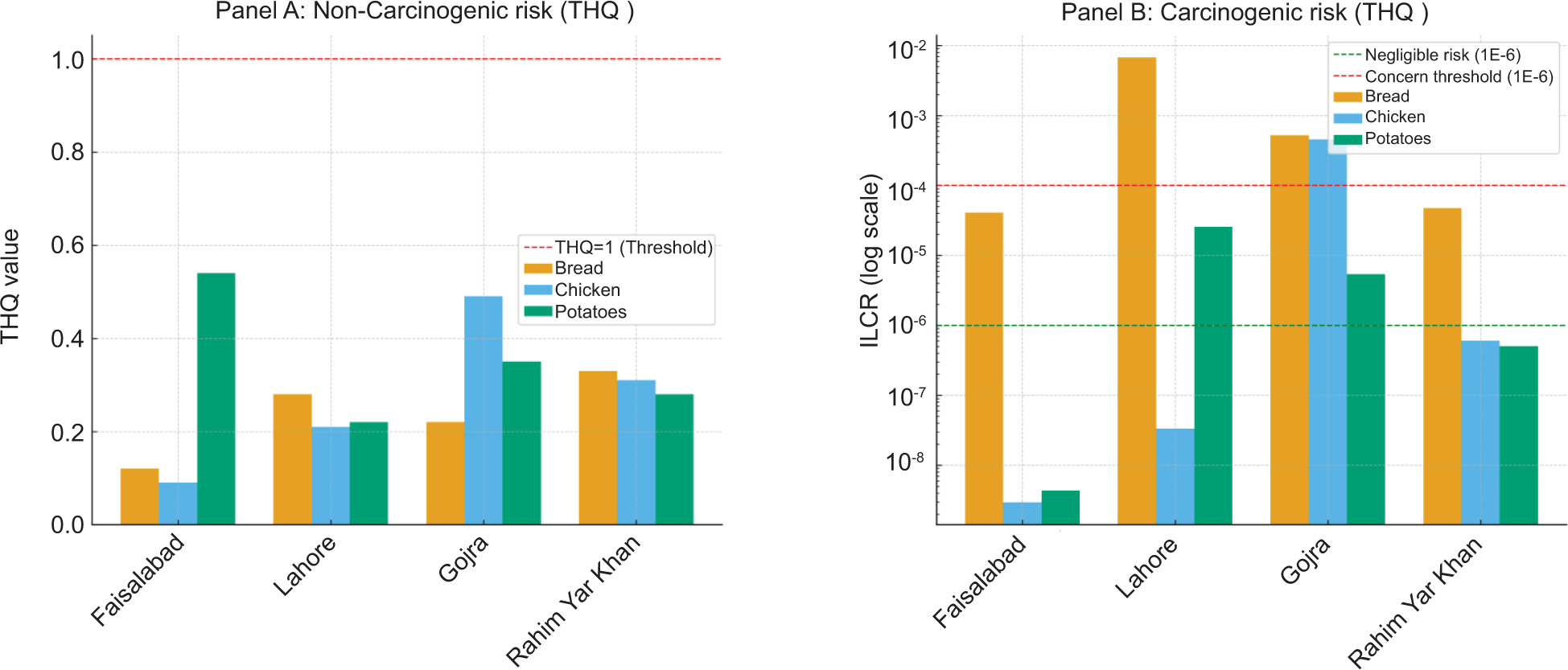
The THQ values for chicken, bread, and potato items collected from the cities under survey are shown in Panel A. There was no noticeable noncarcinogenic risk linked to acrylamide intake from these dietary groups, as all THQ values remained below the safety threshold of 1. In comparison to international standards, Panel B showed the ILCR values on a logarithmic scale. Values below 1 × 10⁻⁶ indicate negligible risk, values between 1 × 10⁻⁶ and 1 × 10⁻⁴ indicate tolerable risk, and values above 1 × 10⁻⁴ indicate potential concern. The findings suggest a potential carcinogenic risk that warrants attention, as bread samples from Lahore and Gojra, as well as chicken items from Gojra, exceeded the 1 × 10⁻⁴ threshold. See Figure 2 for a summary for carcinogen and noncarcinogen risk.
Figure 2. Two-panel summary for carcinogen and noncarcinogen risk.
Intake assessment
The dietary exposure of acrylamide in chicken products, potato products, and bread products is shown in Tables 7, 8, and 9. The data represented the acrylamide exposure rates (µg/kg/bodyweight) of various age groups as follows: 0.50 to 19.03 µg/kg/bodyweight for chicken products, 1.80 to 59.33 µg/kg/bodyweight for potato products, and 2.00 to 18.73 µg/kg/bodyweight for bread products, respectively. The results indicate very high dietary intake levels across all products, posing a considerable health hazard to consumers.
Table 7. Intake rate of fast-food groups (chicken) containing acrylamide in the local population.
| Food samples | Faisalabad | Lahore | Gojra | Rahim Yar Khan | |||||
|---|---|---|---|---|---|---|---|---|---|
| Female | Male | Female | Male | Female | Male | Female | Male | ||
| Chicken drumsticks | Consumption of food (g) | 8.93 | 7.23 | 3.12 | 6.26 | 7.09 | 4.91 | 4.87 | 7.34 |
| Average weight (kg) | 60.00 | 75.00 | 55 | 65 | 62 | 70 | 55 | 65 | |
| Occurrence (μg/kg) | 120.5 | 135.4 | 140.7 | 119.7 | |||||
| Dietary exposure μg/kg/bodyweight |
17.93 | 11.61 | 7.68 | 13.04 | 16.08 | 9.86 | 10.59 | 13.51 | |
| Chicken wings | Consumption of food (g) | 8.15 | 4.41 | 6.14 | 6.34 | 3.98 | 2.56 | 2.45 | 5.78 |
| Average weight (kg) | 60.00 | 75.00 | 55 | 70 | 62 | 70 | 55 | 65 | |
| Occurrence (μg/kg) | 11.8 | 16.9 | 46.94 | 11.4 | |||||
| Dietary exposure μg/kg/bodyweight |
1.60 | 0.69 | 1.88 | 1.53 | 3.01 | 1.71 | 0.50 | 1.01 | |
| Burger | Consumption of food (g) | 12.19 | 17.93 | 18.02 | 17.45 | 9.90 | 7.03 | 12.80 | 14.75 |
| Average weight (kg) | 60.00 | 75.00 | 55 | 70 | 62 | 70 | 55 | 65 | |
| Occurrence (μg/kg) | 40.5 | 35.5 | 53.17 | 35.67 | |||||
| Dietary exposure μg/kg/bodyweight |
8.22 | 9.68 | 11.63 | 8.84 | 8.49 | 5.33 | 8.30 | 8.09 | |
| Nuggets | Consumption of food (g) | 8.75 | 6.71 | 4.87 | 9.34 | 8.26 | 10.09 | 4.65 | 3.87 |
| Average weight (kg) | 60.00 | 75.00 | 55 | 70 | 62 | 70 | 55 | 65 | |
| Occurrence (μg/kg) | 75.31 | 53.3 | 40.9 | 65.9 | |||||
| Dietary exposure μg/kg/bodyweight |
8.78 | 6.73 | 4.71 | 7.11 | 5.44 | 5.89 | 5.57 | 3.92 | |
| Grilled chicken | Consumption of food (g) | 3.35 | 2.17 | 9.90 | 5.03 | 9.45 | 4.02 | 3.12 | 6.26 |
| Average weight (kg) | 60.00 | 75.00 | 55 | 70 | 62 | 70 | 55 | 65 | |
| Occurrence (μg/kg) | 102.3 | 80.3 | 90.3 | 78.89 | |||||
| Dietary exposure μg/kg/bodyweight |
5.71 | 2.95 | 14.45 | 5.77 | 13.76 | 5.18 | 4.47 | 7.59 | |
| Tandoori chicken | Consumption of food (g) | 5.47 | 3.10 | 2.09 | 7.00 | 3.12 | 4.15 | 3.87 | 5.19 |
| Average weight (kg) | 60.00 | 75.00 | 55 | 70 | 62 | 70 | 55 | 65 | |
| Occurrence (μg/kg) | 83.9 | 123.9 | 116.4 | 143.9 | |||||
| Dietary exposure μg/kg/bodyweight |
7.64 | 3.46 | 4.70 | 12.39 | 5.85 | 6.90 | 10.12 | 11.48 | |
| Chicken fry | Consumption of food (g) | 9.12 | 2.16 | 5.65 | 2.27 | 8.90 | 6.03 | 3.29 | 5.02 |
| Average weight (kg) | 60.00 | 75.00 | 55 | 70 | 62 | 70 | 55 | 65 | |
| Occurrence (μg/kg) | 87.53 | 82.76 | 132.6 | 103.1 | |||||
| Dietary exposure μg/kg/bodyweight |
13.30 | 2.52 | 8.50 | 2.68 | 19.03 | 11.42 | 6.16 | 7.96 | |
Table 8. Intake rate of fast-food groups (potatoes) containing acrylamide in the Pakistani population.
| Food samples | Faisalabad | Lahore | Gojra | Rahim Yar Khan | |||||
|---|---|---|---|---|---|---|---|---|---|
| Female | Male | Female | Male | Female | Male | Female | Male | ||
| Potato chips | Consumption of food (g) | 8.19 | 7.15 | 4.20 | 5.34 | 2.56 | 3.23 | 5.26 | 2.67 |
| Average weight (kg) | 60.00 | 75.00 | 55 | 65 | 62 | 70 | 55 | 65 | |
| Occurrence (μg/kg) | 434.7 | 532.9 | 523.9 | 423.7 | |||||
| Dietary exposure μg/kg/bodyweight |
59.33 | 41.44 | 40.69 | 43.77 | 21.63 | 24.17 | 40.52 | 17.40 | |
| Potato crisp | Consumption of food (g) | 7.77 | 6.91 | 5.89 | 5.67 | 7.09 | 7.43 | 8.67 | 6.76 |
| Average weight (kg) | 60.00 | 75.00 | 58 | 65 | 62 | 70 | 59 | 65 | |
| Occurrence (μg/kg) | 412.7 | 534.1 | 479.3 | 437.2 | |||||
| Dietary exposure μg/kg/bodyweight |
53.44 | 38.02 | 54.23 | 46.58 | 54.81 | 50.87 | 56.83 | 45.46 | |
| French fries | Consumption of food (g) | 6.66 | 5.34 | 5.89 | 4.02 | 9.76 | 10.45 | 8.12 | 6.54 |
| Average weight (kg) | 60.00 | 75.00 | 55 | 60 | 62 | 70 | 55 | 65 | |
| Occurrence (μg/kg) | 318.7 | 524.5 | 345.4 | 283.6 | |||||
| Dietary exposure μg/kg/bodyweight |
45.46 | 22.69 | 56.16 | 35.14 | 54.37 | 51.56 | 41.86 | 28.53 | |
| Raw potato | Consumption of food (g) | 10.9 | 8.90 | 10.33 | 13.67 | 9.66 | 9.25 | 8.21 | 7.67 |
| Average weight (kg) | 60.00 | 75.00 | 55 | 70 | 51 | 70 | 55 | 65 | |
| Occurrence (μg/kg) | 15.19 | 13.7 | 26.65 | 20.2 | |||||
| Dietary exposure μg/kg/bodyweight |
2.75 | 1.80 | 2.57 | 2.67 | 5.04 | 3.52 | 3.01 | 2.38 | |
| Potato snacks | Consumption of food (g) | 6.73 | 6.12 | 6.45 | 8.63 | 5.78 | 7.23 | 7.48 | 9.10 |
| Average weight (kg) | 60.00 | 75.00 | 55 | 65 | 62 | 70 | 55 | 65 | |
| Occurrence (μg/kg) | 284.34 | 405.7 | 359.7 | 432.3 | |||||
| Dietary exposure μg/kg/bodyweight |
31.89 | 23.17 | 47.57 | 53.86 | 33.53 | 37.15 | 58.79 | 53.87 | |
Table 9. Intake rate of fast-food groups (bread) containing acrylamide in the Pakistani population.
| Food samples | Faisalabad | Lahore | Gojra | Rahim Yar Khan | |||||
|---|---|---|---|---|---|---|---|---|---|
| Female | Male | Female | Male | Female | Male | Female | Male | ||
| Bread | Consumption of food (g) | 4.37 | 4.04 | 3.19 | 4.16 | 6.19 | 5.29 | 5.53 | 4.87 |
| Average weight (kg) | 60.00 | 75.00 | 55 | 65 | 62 | 70 | 55 | 65 | |
| Occurrence (μg/kg) | 49.23 | 57 | 93 | 79.57 | |||||
| Dietary exposure (μg/kg/bodyweight ) |
3.58 | 2.65 | 3.30 | 3.64 | 9.28 | 7.02 | 8.00 | 5.96 | |
| Bread roll | Consumption of food (g) | 4.03 | 4.57 | 6.34 | 5.89 | 3.90 | 4.13 | 3.43 | 3.78 |
| Average weight (kg) | 60.00 | 75.00 | 55 | 65 | 62 | 70 | 55 | 65 | |
| Occurrence (μg/kg) | 51.3 | 48.8 | 74.9 | 89.43 | |||||
| Dietary exposure (μg/kg/bodyweight) |
3.42 | 3.12 | 5.62 | 4.42 | 4.71 | 4.41 | 5.57 | 5.20 | |
| Whole wheat bread | Consumption of food (g) | 3.01 | 3.29 | 3.98 | 4.10 | 3.89 | 5.78 | 5.12 | 3.76 |
| Average weight (kg) | 60.00 | 75.00 | 55 | 65 | 62 | 70 | 55 | 65 | |
| Occurrence (μg/kg) | 123.4 | 98.6 | 137.6 | 91 | |||||
| Dietary exposure (μg/kg/bodyweight) |
6.19 | 5.41 | 7.13 | 6.21 | 8.63 | 11.36 | 8.47 | 5.26 | |
| Roasted bread | Consumption of food (g) | 2.66 | 2.23 | 4.45 | 5.32 | 3.90 | 4.09 | 3.67 | 4.32 |
| Average weight (kg) | 60.00 | 75.00 | 55 | 65 | 62 | 70 | 55 | 60 | |
| Occurrence (μg/kg) | 67.49 | 115.6 | 119 | 133 | |||||
| Dietary exposure (μg/kg/bodyweight) |
2.99 | 2.00 | 9.35 | 9.46 | 7.48 | 6.95 | 8.87 | 9.57 | |
| Chicken sandwich | Consumption of food (g) | 7.12 | 6.67 | 8.73 | 8.03 | 10.12 | 9.78 | 6.54 | 5.98 |
| Average weight (kg) | 60.00 | 75.00 | 55 | 65 | 62 | 70 | 55 | 65 | |
| Occurrence (μg/kg) | 157.9 | 56.4 | 76.13 | 106.4 | |||||
| Dietary exposure (μg/kg/bodyweight) |
18.73 | 14.02 | 8.73 | 6.96 | 12.42 | 10.63 | 12.65 | 9.78 | |
| Potato sandwich | Consumption of food (g) | 8.17 | 9.01 | 6.70 | 6.34 | 7.67 | 9.20 | 8.56 | 7.56 |
| Average weight (kg) | 60.00 | 75.00 | 55 | 65 | 62 | 70 | 55 | 65 | |
| Occurrence (μg/kg) | 61.10 | 73.4 | 123 | 97.6 | |||||
| Dietary exposure (μg/kg/bodyweight) |
8.31 | 7.34 | 8.94 | 7.15 | 15.21 | 16.16 | 15.19 | 11.35 | |
Discussion
Acrylamide levels in fast foods
Incidence of acrylamide in chicken products
Data were collected from different sampling sites with uniform analytical procedures. It fulfilled all performance and analytical criteria according to the scientific opinion of European Food Safety Authority (EFSA) on acrylamide in food, which endorses that any future monitoring program for acrylamide in foods employs homogeneous analytical methods and collects a satisfactory quantity of samples from each food group to yield statistically valid outcomes (EFSA 2015).
The current study found that chicken products, specifically chicken tandoori from Rahim Yar Khan (143.9 ± 3.6 μg/kg) and fried chicken from Gojra (132.6 ± 4.3 μg/kg), had significantly higher acrylamide levels (p ≤ 0.05). Moreover, grilled chicken from Faisalabad also had elevated concentrations (Table 2). These figures are considerably higher than those published by Seilani et al. (2021), who discovered that chicken nuggets cooked in maize oil at 180°C for 3 minutes had acrylamide levels as low as 7.3 ± 0.1 ng/g. The significantly higher results in this study most likely reflect the local cooking methods, particularly the frequent use of oil and deep-frying, which are popular in Pakistan.
In contrast, the impact of local cooking techniques was further supported by Lambert et al. (2018), who found a much lower amount of acrylamide in French ready-to-eat meat/fish meals (14.1 µg/kg). Studies from Egypt (Elsheshtawy et al., 2022) and Spain (Sansano et al., 2017) further support the importance of the preparation technique, which demonstrates that deep-frying significantly increases acrylamide levels compared to grilling (1.70 to 0.54 µg/100 g, p < 0.05). The generation of acrylamide is also dependent on temperature and technique, as shown by Lee et al. (2020). They showed that deep-fat frying results in higher acrylamide levels (up to 6.19 μg/kg) than air-frying (≤3.49 μg/kg). When combined, these comparisons suggest that the elevated levels in this study are likely due to Pakistan’s traditional frying methods, which involve repeatedly heating oil, potentially posing a higher dietary risk than reported in other countries with more standardized cooking methods.
Incidence of acrylamide in potato products
Results indicate that the acrylamide levels in potato products from Lahore were substantially higher (p < 0.05) with amounts of 532.9 ± 11.3 μg/kg for potato chips, 534.1 ± 11.1 μg/kg for crisps, and 524.3 ± 12.2 μg/kg for French fries. The highest concentration of acrylamide was recorded in potato snack samples collected from Rahim Yar Khan, showing significant differences (p ≤ 0.05) from other cities, as shown in Table 3. These levels fall within the broad range reported internationally. For example, Elias et al. (2017) documented that potato crisps had a mean acrylamide concentration of 529–3,300 µg/kg. Esposito et al. (2017) found that potato chips had an average acrylamide concentration of 173-3444 µg/kg. They conducted a comparison analysis and found that potato crisps had the highest acrylamide content, with a mean concentration of 3,444 µg/kg and a median of 968 µg/kg. On the other hand, Lee and Kim (2020) have detected acrylamide in French fries and potato crisps at 546 and 372 μg/kg, respectively. A study conducted on the Malaysian population by Hidayah et al. (2024) reported comparably the highest average levels of acrylamide in potato crisps (772 ± 752 μg/kg) and French fries (415 ± 914 μg/kg), which supports the view that preparation techniques can significantly affect the level of acrylamide in potato-based products across Asian countries.
Similarly, Kafouris et al. (2018) reported acrylamide levels in potato crisps ranging from 10 to 2193 µg/kg, and Abt et al. (2019) reported 5–1,480 µg/kg in French fries. These results are consistent with those of Bušová et al. (2020), who found levels ranging from 83 to 83–1,550 µg/kg in chips, and Mesías et al. (2019), who documented the concentrations of 20–1,068 µg/kg in fries. Verma et al. (2023) reported 1,143.15 µg/kg in Indian chips, which is still higher than the maximum values reported in Pakistan. These results further highlight that acrylamide levels in potato products are high not only in European countries but also in Asian countries, and the inconsistency between international data and our results may be attributed to differences in oil reuse, potato cultivar, processing methods, and frying practices.
Local street vendors and small fast-food restaurants in Pakistan frequently reuse oil and cook at high temperatures, which likely contributes to the comparatively high levels of acrylamide, especially in Rahim Yar Khan. Large-scale industrial producers in Europe might use mitigation techniques such as blanching, controlled frying temperatures, or cultivar selection, which accounts for their wider but frequently higher reported ranges. Crucially, our results also come close to the mean levels for crisps/snacks (308 µg/kg) and fried potato items (389 µg/kg) as stated in the EFSA (2015) opinion, indicating that acrylamide exposure from potato-based foods in Pakistan is comparable to but not necessarily lower than European averages.
Incidence of acrylamide in bread products
Samples collected from Gojra city showed significantly higher levels (p ≤ 0.05) in bread, bread rolls, whole-wheat bread, and potato sandwiches. Furthermore, the highest levels were recorded in roasted bread (133.0 ± 5.1 μg/kg) and chicken sandwich (106.4 ± 3.6 μg/kg) samples from Rahim Yar Khan, indicating notable variation across cities (Table 4).
These levels are lower than those found in studies conducted throughout Europe, where the mean acrylamide levels were found in crispbread in a survey from Poland (430 µg/kg), which were significantly higher than our findings (Mojska et al., 2010). The crispbread had the highest acrylamide levels (674 µg/kg), followed by potato chips (539 µg/kg) and sweet cookies (443 µg/kg) in Finland (Hirvonen et al., 2011).
The maximum acrylamide concentration in roasted bread was almost 5.5 times lower than the highest values found in crispbread, according to our data. It is nteresting to note that the roasted bread readings from Pakistan (133.0 μg/kg) were similar to those obtained from Sangak bread in Iran (135 μg/kg) (Dastmalchi et al., 2016). This suggests that traditional bread-making techniques in nearby regions might yield acrylamide levels comparable to those in this region.
Khaneghah et al. (2022) have revealed additional evidence, reporting mean acrylamide levels of 133.12 µg/kg in bread, which is in close agreement with our findings for roasted bread. Higher values were observed in potato-based foods (740.33 µg/kg) and fried foods (328.65 µg/kg). These findings showed that, compared with potato-based products, bread products in Pakistan result in a detectable but moderate level of acrylamide exposure. Differences in flour type, fermentation time, baking temperature, and ingredient composition (such as sugar or amino acid concentration) are likely the causes of variation across research. The greater results observed in roasted bread compared to regular loaves may be explained by high--temperature baking and toasting, which may further increase acrylamide formation.
Intake assessment
The dietary exposure assessment from the study indicated that acrylamide intake varied between 0.50 and 17.93 µg/kg BW/day for chicken products, 2.00 to 18.73 µg/kg BW/day for bread products, and 1.80 to 59.33 µg/kg BW/day for potato products (Tables 7–9). These numbers raise significant concerns about public health in Pakistan, as they reflect considerably higher exposure levels in all food categories. Reports from the Joint FAO/WHO Expert Committee on Food Additives (JECFA) noted that potato products (such as crisps and French fries), along with chicken, bread, bread rolls, and biscuits, were the primary contributors to dietary exposure (FAO/WHO 2010).
Similarly, Yu et al. (2023) reported the estimated dietary intake in Singapore of 0.392 µg/kg BW/day for high consumers and 0.165 µg/kg BW/day for general consumers, while Bellicha et al. (2022) found a mean intake of 30.1 ± 21.9 µg/day, with the primary sources being potato chips/fries, coffee, and bread. The maximum, mean, and minimum exposures in Turkey were 6.41, 1.43, and 0.06 µg/kg BW/day, as reported by Cengiz & Gündüz (2013). These values are significantly lower than those in Pakistan. In comparison to Pakistani findings, EFSA (2015) has estimated average intakes at 1.2–2.4 µg/kg BW/day for toddlers, 0.70–2.05 µg/kg BW/day for children, and ≥1.5 µg/kg BW/day for adolescents and adults. Similarly, another study from the capital city of Turkey (Ankara), conducted by Demirok Soncu et al. (2018), documented the highest total acrylamide exposure at 0.017 µg/kg BW/day. For women, the mean consumption ranged from 12 to 41 μg daily, while for men, it ranged from 15 to 48 μg daily (Eslamizad et al., 2019). However, the amounts reported in this study are significantly higher than JECFA’s benchmark values of 1 µg/kg BW/day (mean) and 4 µg/kg BW/day (high percentile), suggesting that Pakistani consumers may be exposed to levels that are several times greater than globally accepted safe standards.
Risk assessment
Comparison between THQ and CDI
The CDI and THQ values differ when comparing them city-wise. Faisalabad showed the highest CDI values for potatoes but comparatively low values for bread and chicken. Rahim Yar Khan showed high bread values. On the other hand, THQ values for all food types are high in samples collected from Lahore city but are below the t1 threshold, whereas those from Gojra city show moderate levels of CDI and THQ. These differences imply that local dietary patterns differ specifically. The intake of potatoes in Faisalabad, bread in Rahim Yar Khan, and chicken in Lahore affects acrylamide exposure and may put people in Pakistan at risk of health problems.
It is essential to keep in mind that exposure to acrylamide can come from a variety of sources and foods, even though the computed THQ values are less than 1, indicating no significant risk. However, the elevated ILCR values ( > 1 × 10⁻⁵) suggest possible long-term cancer risks for both adults and children. These findings differ from those of Seilani et al. (2021), who reported THQ and ILCR values for chicken, meat, and shrimp nuggets in the safe range (< 1×10⁻⁴), highlighting that Pakistani consumers may face comparatively higher risks. Although most studies found no statistically significant correlation between intake of dietary acrylamide and any of the cancers (Benisi-Kohansal et al., 2021; Filippini et al., 2022), a few studies found increased risk for renal, endometrial, and ovarian cancers (Virk-Baker et al., 2014).
According to the MOE methodology, the exposures in this investigation demonstrate narrow margins of safety, as they remain significantly below the EFSA-established reference benchmarks for neurotoxicity (430 μg/kg BW/day) and carcinogenicity (170 μg/kg BW/day). These results underscore the importance of local risk management plans, particularly for -controlling acrylamide production in commonly -consumed foods.
Mitigation strategies for acrylamide reduction
At both the industrial and domestic levels, several methods have been proposed by European Regulation (EU) and Food and Drug Administration (FDA) to reduce the formation of acrylamide in carbohydrate-rich foods without changing the sensory attributes such as appearance, texture, and taste. Acrylamide levels rise when foods are heated to 120°C for extended periods. One of the most effective household practices to reduce acrylamide formation is managing the cooking time and temperature (Maan et al., 2022; Peivasteh-Roudsari et al., 2024). Moisture content is another factor contributing to acrylamide formation. Lowering the moisture/water content in foods reduces acrylamide formation (Ahmed and Mohammed, 2024; Govindaraju et al., 2024).
The amount of acrylamide is considerably reduced when potatoes are blanched before frying (Ahmed and Mohammed, 2024; Gökmen, 2023; Negoiță et al., 2022). This method involves soaking food items in hot water for a short time before cooking and is effective at reducing acrylamide levels. This method maintains uniformity, improves texture, and prevents enzymatic browning by removing soluble sugars from food (Maan et al., 2022; Zhang et al., 2020).
Genetic engineering has been u commercial level to produce low-acrylamide potato vrieties by suppressing the genes responsible for free asparagine and starch breakdown, an by decreasing vacuolar invertase activity to reduce cold sweetening (Halford 2018; Halford et al., 2022). Addition, vacuum-frying lowers acrylamide concentration in foods (Manzoor et al., 2023; Pandiselvam et al., 2024; Verma et al., 2023). Keeping the temperature lower while applying pressure eliminates water content and lowers the concentration of precursors to the Maillard reaction. Food additives derived from natural sources, such as fruit peels, bamboo leaves, rosemary extract, and green tea extract, have also been shown to significantly reduce acrylamide levels (Abedini et al., 2024; El-Sayed et al., 2023; Sharif et al., 2022). Another study found that using citric acid and calcium chloride at various concentrations before frying could reduce acrylamide production by up to 91% (Bruno et al., 2024). Fermentation is another crucial method for reducing acrylamide formation (Pandiselvam et al., 2024; Zhou et al., 2022). According to specific research, using Lactobacillus plantarum and Streptococcus lutetiensis for lactic acid fermentation of food resulted in 39% and 26% decreases in acrylamide, respectively (Albedwawi et al., 2022; Govindaraju et al., 2024).
Highlighting the effectiveness of addressing oil reuse practices, studies have demonstrated that treating old palm oil with corncob biochar redt of acrylalevels mide in fried foods by half while preserving oil quality and providing sustainable recycling opportunities (Chathiran et al., 2024). Also, the use of natural antioxidants like sesame seed extract, vitamin E, green tea extract, and rosemary extract can prolong oil stability and reduce the production of acrylamide when frying repeatedly (Erickson et al., 2023; Permana et al., 2022). One of the most effective natural antioxidants is rosemary (Rosmarinus officinalis L.) extract (ROE), which can significantly reduce oil oxidation when stored or heated (Song et al., 2023).
Conclusion
In this study, acrylamide content was analyzed in various food types (potatoes, chicken, and bread) collected from markets and supermarkets in Pakistan, and dietary intake and associated cancer risk were estimated. Acrylamide levels were considerably high across all food categories. Furthermore, statistically significant differences (p ≤ 0.05) were observed between food types and acrylamide levels, whereas no significant difference (p ≥ 0.05) was observed between acrylamide levels and sampling locations. While THQ values were below 1, indicating no immediate hazard, the ILCR values for both adults and children exceeded the USEPA threshold of 1 × 10⁻⁵, suggesting a potential long-term carcinogenic risk. As a result, more research is required to monitor acrylamide levels in various food products, estimate average dietary intake, and evaluate the health risks associated with acrylamide in Pakistan’s staple foods. The results of the present study will help collect data that agencies, traders, and consumers can use to raise awareness of the toxic health hazard posed by acrylamide.
Several suggestions can be made to better understand and control acrylamide exposure from frequently consumed foods in Pakistan based on the study’s findings. To establish acceptable levels and mitigation practices, regulatory bodies such as the Pakistan Standards and Quality Control Authority may develop national guidelines or adopt international benchmarks, in line with organizations such as the WHO and the ESFA. Food producers and suppliers should also be urged to make processing changes, such as selecting appropriate raw materials, optimizing cooking temperatures and times, and, when practical, using mitigation techniques, such as enzymatic treatment. Initiatives to raise public awareness are also crucial for educating consumers about ways to reduce acrylamide formation when cooking at home, such as by avoiding over-browning food. To improve the accuracy of exposure assessments across diverse population groups, future studies should increase sample sizes, cover a broader range of foods, and include comprehensive dietary intake data.
Acknowledgments
The Department of Applied Chemistry, Laboratory of Government College University, Faisalabad, Pakistan provided experimental materials for this study.
Mandatory Disclosure on Use of Artificial Intelligence
Quillbot is used for English grammar checking and improvement and is verified through proofreading.
Author Contributions
Conceptualization was done by S.Z.I.; methodology was looked into by A.L. and S.Z.I.; software was handled by S.Z.I.; validation was done by S.Z.I. and G.M.K.; formal analysis was the responsibility of A.L.; investigation was done by A.F.; data curation was handled by S.Z.I.; writing—original draft preparation was done by A.L.; writing—review and editing was looked into by S.Z.I. and G.M.K.; visualization was done by X.X.; supervision was done by S.Z.I and G.M.K. All authors have read and agreed to the published version of the manuscript.
Conflicts of Interest
The authors declare no conflicts of interest in this research.
Funding
This research has not received any internal or external grants.
REFERENCES
Abedini, A.H., Vakili Saatloo, N., Salimi, M., Sadighara, P., Alizadeh Sani, M., Garcia-Oliviera, P., Prieto, M.A., Kharazmi, M.S., and Jafari, S.M. 2024. The role of additives on acrylamide formation in food products: A systematic review. Critical Reviews in Food Science and Nutrition 64(10): 2773. 10.1080/10408398.2022.2126428
Abt, E., Robin, L.P., McGrath, S., Srinivasan, J., DiNovi, M., Adachi, Y., and Chirtel, S. 2019. Acrylamide levels and dietary exposure from foods in the United States, an update based on 2011–2015 data. Food Additives & Contaminants: Part A 36(10): 1475. 10.1080/19440049.2019.1637548
Ahmed, Z.A., and Mohammed, N.K. 2024. Investigating influencing factors on acrylamide content in fried potatoes and mitigating measures: A review. Food Production, Processing and Nutrition 6(1): 24. 10.1186/s43014-023-00212-6
Ahmed, Z.A., Mohammed, N.K., and Hussin, A.S.M. 2023. Acrylamide content and quality characteristics of French fries influenced by different frying methods. Functional Foods in Health and Disease 13(6): 320. 10.31989/ffhd.v13i6.1126
Albedwawi, A.S., Al Sakkaf, R., Yusuf, A., Osaili, T.M., Al-Nabulsi, A., Liu, S.Q., Palmisano, G., and Ayyash, M.M. 2022. Acrylamide elimination by lactic acid bacteria: Screening, optimization, in vitro digestion and mechanism. Microorganisms 10(3): 557. 10.3390/microorganisms10030557
Bellicha, A., Wendeu-Foyet, G., Coumoul, X., Koual, M., Pierre, F., Guéraud, F., Zelek, L., Debras, C., Srour, B., and Sellem, L. 2022. Dietary exposure to acrylamide and breast cancer risk: Results from the NutriNet-Santé cohort. The American Journal of Clinical Nutrition 116(4): 911. 10.1093/ajcn/nqac167
Benisi-Kohansal, S., Salari-Moghaddam, A., Rohani, Z.S., and Esmaillzadeh, A. 2021. Dietary acrylamide intake and risk of women’s cancers: A systematic review and meta-analysis of prospective cohort studies. British Journal of Nutrition 126(9): 1355. 10.1017/S0007114520005255
Bouchon, P., and Dueik, V. 2018. Frying of foods of chapter. In: editor. Fruit Preservation: Novel and Conventional Technologies. Springer: 275. 10.1007/978-1-4939-3311-2_10
Bruno, F., Ledbetter, M., Davies, B., Riedinger, L., Blidi, S., Sturrock, K., McNamara, G., Montague, G., and Fiore, A. 2024. Effect of ultrasound and additives treatment as mitigation strategies to reduce acrylamide formation in potato crisps on industrial scale. Food Science & Technology 197: 115876. 10.1016/j.lwt.2024.115876
Bušová, M., Bencko, V., Kromerová, K., Nadjo, I., and Babjaková, J. 2020. Occurrence of acrylamide in selected food products. Central European Journal of Public Health 28(4): 320. 10.21101/cejph.a6430
Cengiz, M.F., and Gündüz, C.P.B. 2013. Acrylamide exposure among Turkish toddlers from selected cereal-based baby food samples. Food and Chemical Toxicology 60: 514–519. 10.1016/j.fct.2013.08.018
Chathiran, W., On-nom, N., Somsong, P., Tiyayon, P., Niranjan, K., and Srichamnong, W. 2024. The efficacy and lipid degradation properties resulting from corncob biochar treatment for acrylamide reduction in reused palm oil. Food Science & Technology 192: 115720. 10.1016/j.lwt.2023.115720
Dadar, M., Adel, M., Nasrollahzadeh Saravi, H., and Fakhri, Y. 2017. Trace element concentration and its risk assessment in common kilka (Clupeonella cultriventris caspia Bordin, 1904) from southern basin of Caspian Sea. Toxin Reviews 36(3): 222. 10.1080/15569543.2016.1274762
Dastmalchi, F., Razavi, S.H., Faraji, M., and Labbafi, M. 2016. Effect of Lactobacillus casei-casei and Lactobacillus reuteri on acrylamide formation in flat bread and Bread roll. Journal of Food Science and Technology 53(3): 1531. 10.1007/s13197-015-2118-3
Demirok Soncu, E., Haskaraca, G., and Kolsarıcı, N. 2018. Presence of acrylamide and heterocyclic aromatic amines in breaded chicken meat products and dietary exposure of Turkish population from Ankara based on the food frequency questionnaire study. European Food Research and Technology 244(3): 501. 10.1007/s00217-017-2976-1
Deshmukh, R. 2019. The effect of repeatedly cooking oils on health and wealth of a country: A short communication. Journal of Food Processing and Technology. 10(8): 1. 10.35248/2157-7110.19.10.807
EFSA. 2015. Scientific opinion on acrylamide in food. EFSA Journal. 13 (6) (4104). 10.2903/j.efsa.2015.4104
El-Sayed, A.A., Abdelhady, M.M., Jaafari, S.A., Alanazi, T.M., and Mohammed, A.S. 2023. Impact of some enzymatic treatments on acrylamide content in biscuits. Processes 11(4): 1041. 10.3390/pr11041041
Elias, A., Roasto, M., Reinik, M., Nelis, K., Nurk, E., and Elias, T. 2017. Acrylamide in commercial foods and intake by infants in Estonia. Food Additives & Contaminants: Part A 34(11): 1875. 10.1080/19440049.2017.1347283
Elsheshtawy, M., Salem, A., Elsabagh, R., and Sabeq, I. 2022. Acrylamide Assessment in meat products sold in Al-Qalubyia, Egypt, and the impacts of different cooking methods on their levels. Benha Journal of Applied Sciences 7(5): 211. 10.21608/bjas.2022.283023
Erickson, M.D., Yevtushenko, D.P., and Lu, Z.X. 2023. Oxidation and thermal degradation of oil during frying: A review of natural antioxidant use. Food Reviews International 39(7): 4665. 10.1080/87559129.2022.2039689
Eslamizad, S., Kobarfard, F., Tsitsimpikou, C., Tsatsakis, A., Tabib, K., and Yazdanpanah, H. 2019. Food and Chemical Toxicology 126: 162–168. 10.1016/j.fct.2019.02.019
Esposito, F., Nardone, A., Fasano, E., Triassi, M., and Cirillo, T. 2017. Determination of acrylamide levels in potato crisps and other snacks and exposure risk assessment through a margin of exposure approach. Food and Chemical Toxicology 108: 249–256. 10.1016/j.fct.2017.08.006
FAO/WHO. 2010. Evaluation of certain food contaminants. Seventy-second report of the joint FAo/WHO expert committee on food additives. http://www.fao.org/ag/agn/agns/jecfa%7B_%7-Dindex%7B_%7Den.asp.
Fathabad, A.E., Shariatifar, N., Moazzen, M., Nazmara, S., Fakhri, Y., Alimohammadi, M., Azari, A., and Khaneghah, A.M. 2018. Determination of heavy metal content of processed fruit products from Tehran’s market using ICP-OES: A risk assessment study. Food and Chemical Toxicology. 115: 436–446. 10.1016/j.fct.2018.03.044
Fikry, M., Khalifa, I., Sami, R., Khojah, E., Ismail, K.A., and Dabbour, M. 2021. Optimization of the frying temperature and time for preparation of healthy falafel using air frying technology. Foods 10(11): 2567. 10.3390/foods10112567
Filippini, T., Halldorsson, T.I., Capitao, C., Martins, R., Giannakou, K., Hogervorst, J., Vinceti, M., Åkesson, A., Leander, K., and Katsonouri, A. 2022. Dietary acrylamide exposure and risk of site-specific cancer: A systematic review and dose--response meta-analysis of epidemiological studies. Frontiers in Nutrition. 9: 875607. 10.3389/fnut.2022.875607
Ghasemidehkordi, B., Malekirad, A.A., Nazem, H., Fazilati, M., Salavati, H., Shariatifar, N., Rezaei, M., Fakhri, Y., and Khaneghah, A.M. 2018. Concentration of lead and mercury in collected vegetables and herbs from Markazi province, Iran: A non-carcinogenic risk assessment. Food and Chemical Toxicology. 113 204–210. 10.1016/j.fct.2018.01.048
Gökmen, V. 2023. Acrylamide in thermally processed potato products. Potato Research 66(4): 1315. 10.1007/s11540-023-09634-8
Govindaraju, I., Sana, M., Chakraborty, I., Rahman, M.H., Biswas, R., and Mazumder, N. 2024. Dietary acrylamide: A detailed review on formation, detection, mitigation, and its health impacts. Foods 13(4): 556. 10.3390/foods13040556
Halford, N.G. 2018. Managing acrylamide at the agricultural stage: Variety selection, crop management, and the prospects for solving the acrylamide problem through plant breeding and biotechnology. In: Encyclopedia of Food Chemistry, 1: 559–568. 10.1016/B978-0-08-100596-5.21821-0
Halford, N.G., Raffan, S., and Oddy, J. 2022. Progress towards the production of potatoes and cereals with low acrylamide-forming potential. Current Opinion in Food Science 47: 100887. 10.1016/j.cofs.2022.100887
Hamzalıoğlu, A., and Gökmen, V. 2019. Formation of acrylamide in thermally processed foods and its reactionsduring in vitro digestion of chapter. In: editor. Food-Borne Toxicants: Formation, Analysis, and Toxicology. ACS Publications: 45. 10.1021/bk-2019-1306.ch004
Heshmati, A., Ghadimi, S., Khaneghah, A.M., Barba, F.J., Lorenzo, J.M., Nazemi, F., and Fakhri, Y. 2018. Risk assessment of benzene in food samples of Iran’s market. Food and Chemical Toxicology. 114: 278. 10.1016/j.fct.2018.02.043
Hidayah, J.N., Razis, A.F.A., Jambari, N.N., Chai, L.C., You, L., and Sanny, M. 2024. Dietary exposure to acrylamide among the Malaysian adult population. Food and Chemical Toxicology. 185: 114502. 10.1016/j.fct.2024.114502
Hirvonen, T., Jestoi, M., Tapanainen, H., Valsta, L., Virtanen, S.M., Sinkko, H., Kronberg-Kippilä, C., Kontto, J., Virtamo, J., and Simell, O. 2011. Dietary acrylamide exposure among Finnish adults and children: The potential effect of reduction measures. Food Additives & Contaminants: Part A 28(11): 1483. 10.1080/19440049.2011.593559
IRIS. 2010. Acrylamide; CASRN 79-06-1. IRIS Assessment. https://cfpub.epa.gov/ncea/iris2/chemicalLanding.cfm?substance_nmbr=286.
Jahanbakhsh, M., Afshar, A., Momeni Feeli, S., Pabast, M., Ebrahimi, T., Mirzaei, M., Akbari-Adergani, B., Farid, M., and Arabameri, M. 2021. Probabilistic health risk assessment (Monte Carlo simulation method) and prevalence of aflatoxin B1 in wheat flours of Iran. International Journal of Environmental Analytical Chemistry 101(8): 1074. 10.1080/03067319.2019.1676421
Jeong, H., Hwang, S., and Kwon, H. 2020. Survey for acrylamide in processed foods from Korean market and individual exposure estimation using a non-parametric probabilistic model. Food Additives & Contaminants: Part A 37(6): 916. 10.1080/19440049.2020.1746410
Kafouris, D., Stavroulakis, G., Christofidou, M., Iakovou, X., Christou, E., Paikousis, L., Christodoulidou, M., Ioannou-Kakouri, E., and Yiannopoulos, S. 2018. Determination of acrylamide in food using a UPLC–MS/MS method: Results of the official control and dietary exposure assessment in Cyprus. Food Additives & Contaminants: Part A 35(10): 1928. 10.1080/19440049.2018.1508893
Kaur, N., and Halford, N.G. 2023. Reducing the risk of acrylamide and other processing contaminant formation in wheat products. Foods 12(17): 3264. 10.3390/foods12173264
Khaneghah, M. A., Fakhri, Y., Nematollahi, A., Seilani, F., and Vasseghian, Y. 2022. The concentration of acrylamide in different food products: A global systematic review, meta-analysis, and meta-regression. Food Reviews International 38(6): 1286. 10.1080/87559129.2020.1791175
Koszucka, A., and Nowak, A. 2019. Thermal processing food--related toxicants: A review. Critical Reviews in Food Science and Nutrition. 59(22): 3579. 10.1080/10408398.2018.1500440
Kumari, A., Bhattacharya, B., Agarwal, T., Paul, V., and Chakkaravarthi, S. 2022. Integrated approach towards acrylamide reduction in potato-based snacks: A critical review. Food Research International 156: 111172. 10.1016/j.foodres.2022.111172
Lambert, M., Inthavong, C., Hommet, F., Leblanc, J.C., Hulin, M., and Guerin, T. 2018. Levels of acrylamide in foods included in ‘the first French total diet study on infants and toddlers’. Food Chemistry. 240: 997–1004. 10.1016/j.foodchem.2017.08.035
Lee, J.S., Han, J.W., Jung, M., Lee, K.W., and Chung, M.S. 2020. Effects of thawing and frying methods on the formation of acrylamide and polycyclic aromatic hydrocarbons in chicken meat. Foods 9(5): 573. 10.3390/foods9050573
Lee, S., and Kim, H.J. 2020. Dietary exposure to acrylamide and associated health risks for the Korean population. International Journal of Environmental Research and Public Health. 17(20): 7619. 10.3390/ijerph17207619
Maan, A.A., Anjum, M.A., Khan, M.K.I., Nazir, A., Saeed, F., Afzaal, M., and Aadil, R.M. 2022. Acrylamide formation and different mitigation strategies during food processing–A review. Food Reviews International 38(1): 70. 10.1080/87559129.2020.1719505
Madani-Tonekaboni, M., Rafiei Nazari, R., Mirzamohammadi, S., Abdolshahi, A., Abbasi-bastami, N., and Arabameri, M. 2019. Monitoring and risk assessment of lead and cadmium in milks from east of Iran using Monte Carlo simulation method. Nutrition and Food in Health and Disease 6(2): 29. 10.29252/nfsr.6.2.29
Manzoor, S., Masoodi, F., Rashid, R., Wani, S.M., Naqash, F., and Ahmad, M. 2023. Advances in vacuum frying: Recent developments and potential applications. Journal of Food Process Engineering 46(2): e14219. 10.1111/jfpe.14219
Mesías, M., Delgado-Andrade, C., Holgado, F., and Morales, F.J. 2019. Acrylamide content in French fries prepared in food service establishments. Food Science & Technology 100(83. 10.1016/j.lwt.2018.10.050
Michalak, J., Czarnowska-Kujawska, M., Klepacka, J., and Gujska, E. 2020. Effect of microwave heating on the acrylamide formation in foods. Molecules 25(18): 4140. 10.3390/molecules25184140
Mojska, H., Gielecińska, I., Szponar, L., and Ołtarzewski, M. 2010. Estimation of the dietary acrylamide exposure of the Polish population. Food and Chemical Toxicology 48(8–9): 2090. 10.1016/j.fct.2010.05.009
Mucci, L.A., and Wilson, K.M. 2008. Acrylamide intake through diet and human cancer risk. Journal of Agricultural and Food Chemistry 56(15): 6013. 10.1021/jf703747b
Naji, Y.A.M., Alam, M., Bashir, S., and Kadir, N.H.A. 2025. Bibliometric exploration of the state of the art on acrylamide and glycidamide in food safety. Beni-Suef University Journal of Basic and Applied Sciences 14(1): 52. 10.1186/s43088-025-00639-5
Negoiță, M., Mihai, A.L., and Horneț, G.A. 2022. Influence of water, NaCl and citric acid soaking pre-treatments on acrylamide content in French fries prepared in domestic conditions. Foods. 11(9): 1204. 10.3390/foods11091204
Pacetti, D., Gil, E., Frega, N.G., Álvarez, L., Dueñas, P., Garzón, A., and Lucci, P. 2015. Acrylamide levels in selected Colombian foods. Food Additives & Contaminants: Part B 8(2): 99. 10.1080/19393210.2014.995236
Pandiselvam, R., Süfer, Ö., Özaslan, Z.T., Gowda, N.N., Pulivarthi, M.K., Charles, A.P.R., Ramesh, B., Ramniwas, S., Rustagi, S., and Jafari, Z. 2024. Acrylamide in food products: Formation, technological strategies for mitigation, and future outlook. Food Frontiers 5(3): 1063. 10.1002/fft2.368
Peivasteh-Roudsari, L., Karami, M., Barzegar-Bafrouei, R., Samiee, S., Karami, H., Tajdar-Oranj, B., Mahdavi, V., Alizadeh, A.M., Sadighara, P., and Oliveri Conti, G. 2024. Toxicity, metabolism, and mitigation strategies of acrylamide: A comprehensive review. International Journal of Environmental Health Research 34(1): 1. 10.1080/09603123.2022.2123907
Perestrelo, S., Schwerbel, K., Hessel-Pras, S., Schäfer, B., Kaminski, M., Lindtner, O., and Sarvan, I. 2024. Results of the BfR MEAL Study: Acrylamide in foods from the German market with highest levels in vegetable crisps. Food Chemistry: X. 22: 101403. 10.1016/j.fochx.2024.101403
Pietropaoli, F., Pantalone, S., Cichelli, A., and d’Alessandro, N. 2022. Acrylamide in widely consumed foods–A review. Food Additives & Contaminants: Part A 39(5): 853. 10.1080/19440049.2022.2046292
Rahman, N.S.A.A., and Malik, N.H. 2023. Comparative study between deep-fat frying and air frying of sweet potato perkedel. Enhanced Knowledge in Sciences and Technology 3(2): 344.
Razia, S., Bertrand, M., Klaus, V., and Meinolf, G. 2016. Investigation of acrylamide levels in branded biscuits, cakes and potato chips commonly consumed in Pakistan. International Food Research Journal 23(5): 2187–2192.
Samiee, S., Fakhri, Y., Sadighara, P., Arabameri, M., Rezaei, M., Nabizadeh, R., Shariatifar, N., and Mousavi Khaneghah, A. 2020. The concentration of polycyclic aromatic hydrocarbons (PAHs) in the processed meat samples collected from Iran’s market: A probabilistic health risk assessment study. Environmental Science and Pollution Research. 27(17): 21126. 10.1007/s11356-020-08413-z
Sansano, M., Heredia, A., Peinado, I., and Andrés, A. 2017. Dietary acrylamide: What happens during digestion. Food Chemistry. 237(58–64). 10.1016/j.foodchem.2017.05.104
Seilani, F., Shariatifar, N., Nazmara, S., Khaniki, G.J., Sadighara, P., and Arabameri, M. 2021. The analysis and probabilistic health risk assessment of acrylamide level in commercial nuggets samples marketed in Iran: Effect of two different cooking methods. Journal of Environmental Health Science and Engineering 19(1): 465. 10.1007/s40201-021-00619-8
Shahrbabki, P.E., Hajimohammadi, B., Shoeibi, S., Elmi, M., Yousefzadeh, A., Conti, G.O., Ferrante, M., Amirahmadi, M., Fakhri, Y., and Khaneghah, A.M. 2018. Probabilistic non--carcinogenic and carcinogenic risk assessments (Monte Carlo simulation method) of the measured acrylamide content in Tah-dig using QuEChERS extraction and UHPLC-MS/MS. Food and Chemical Toxicology 118: 361–370. 10.1016/j.fct.2018.05.038
Shariatifar, N., Rezaei, M., Alizadeh Sani, M., Alimohammadi, M., and Arabameri, M. 2020. Assessment of rice marketed in Iran with emphasis on toxic and essential elements; effect of different cooking methods. Biological Trace Element Research 198(2): 721. 10.1007/s12011-020-02110-1
Sharif, R., Shahar, S., Rajab, N.F., and Fenech, M. 2022. Dietary-pattern, genomic stability and relative cancer risk in Asian food landscape. Nutrition and Cancer 74(4): 1171. 10.1080/01635581.2021.1952627
Song, X., Sui, X., and Jiang, L. 2023. Protection function and mechanism of rosemary (Rosmarinus officinalis L.) extract on the thermal oxidative stability of vegetable oils. Foods 12(11): 2177. 10.3390/foods12112177
Taghizadeh, S.F., Badibostan, H., Hayes, A.W., Giesy, J.P., and Karimi, G. 2021. Residues levels of pesticides in walnuts of Iran and associated health risks. Human and Ecological Risk Assessment: An International Journal 27(1): 191. 10.1080/10807039.2019.1704619
Taghizadeh, S.F., Goumenou, M., Rezaee, R., Alegakis, T., Kokaraki, V., Anesti, O., Sarigiannis, D.A., Tsatsakis, A., and Karimi, G. 2019. Cumulative risk assessment of pesticide residues in different Iranian pistachio cultivars: Applying the source specific HQS and adversity specific HIA approaches in Real Life Risk Simulations (RLRS) Toxicology Letters 313: 91–100. 10.1016/j.toxlet.2019.05.019
Tareke, E., Rydberg, P., Karlsson, P., Eriksson, S., and Törnqvist, M. 2002. Analysis of acrylamide, a carcinogen formed in heated foodstuffs. Journal of Agricultural and Food Chemistry 50(17): 4998. 10.1021/jf020302f
Verma, V., Singh, V., Chauhan, O.P., and Yadav, N. 2023. Comparative evaluation of conventional and advanced frying methods on hydroxymethylfurfural and acrylamide formation in French fries. Innovative Food Science & Emerging Technologies 83: 103233. 10.1016/j.ifset.2022.103233
Virk-Baker, M.K., Nagy, T.R., Barnes, S., and Groopman, J. 2014. Dietary acrylamide and human cancer: A systematic review of literature. Nutrition and Cancer 66(5): 774. 10.1080/01635581.2014.916323
Yu, W.Z., Shen, P., Lim, I., Shi, R.R.S., Cai, M., Chin, Y.S., Tay, A.J., Ang, W.M., Er, J.C., and Lim, G.S. 2023. Occurrence and dietary exposure to acrylamide from foods consumed within and outside main meals in Singapore. Foods 12(16): 3022. 10.3390/foods12163022
Zhang, X., Zhang, M., and Adhikari, B. 2020. Recent developments in frying technologies applied to fresh foods. Trends in Food Science & Technology. 98: 68–81. 10.1016/j.tifs.2020.02.007
Zhou, X., Duan, M., Gao, S., Wang, T., Wang, Y., Wang, X., and Zhou, Y. 2022. A strategy for reducing acrylamide content in wheat bread by combining acidification rate and prerequisite substance content of Lactobacillus and Saccharomyces cerevisiae. Current Research in Food Science 5: 1054–1060. 10.1016/j.crfs.2022.06.005